AI Assistant vs Virtual Assistant for Property Managers: Which is Better?
Get expert property management insights, straight to your inbox.
Property managers choosing between an AI assistant and a virtual assistant face a real decision: automation or human support, speed or judgment.
The choice matters more now as tenant communication volume grows and teams stay lean.
This article compares both options side by side, tasks, cost, availability, accuracy, and scale, so you can decide what fits your portfolio today and what holds up as it grows.
What is an AI Assistant in Property Management?
An AI assistant in property management is software that executes routine property management tasks autonomously, without waiting for human input. The work usually includes tenant communication, maintenance requests, rent reminders, basic tenant screening, and recurring administrative support. Each action follows predefined rules connected directly to the property management system.
AI assistants do not rely on chat prompts or manual commands. AI agents provide 24/7 support, allowing property managers to focus on high-value tasks.
The system reads incoming tenant messages, identifies the request type, pulls the correct property information, and automatically creates the appropriate work orders or updates issue tracking. Every step connects back to the same system used for daily operations, keeping records consistent and searchable.
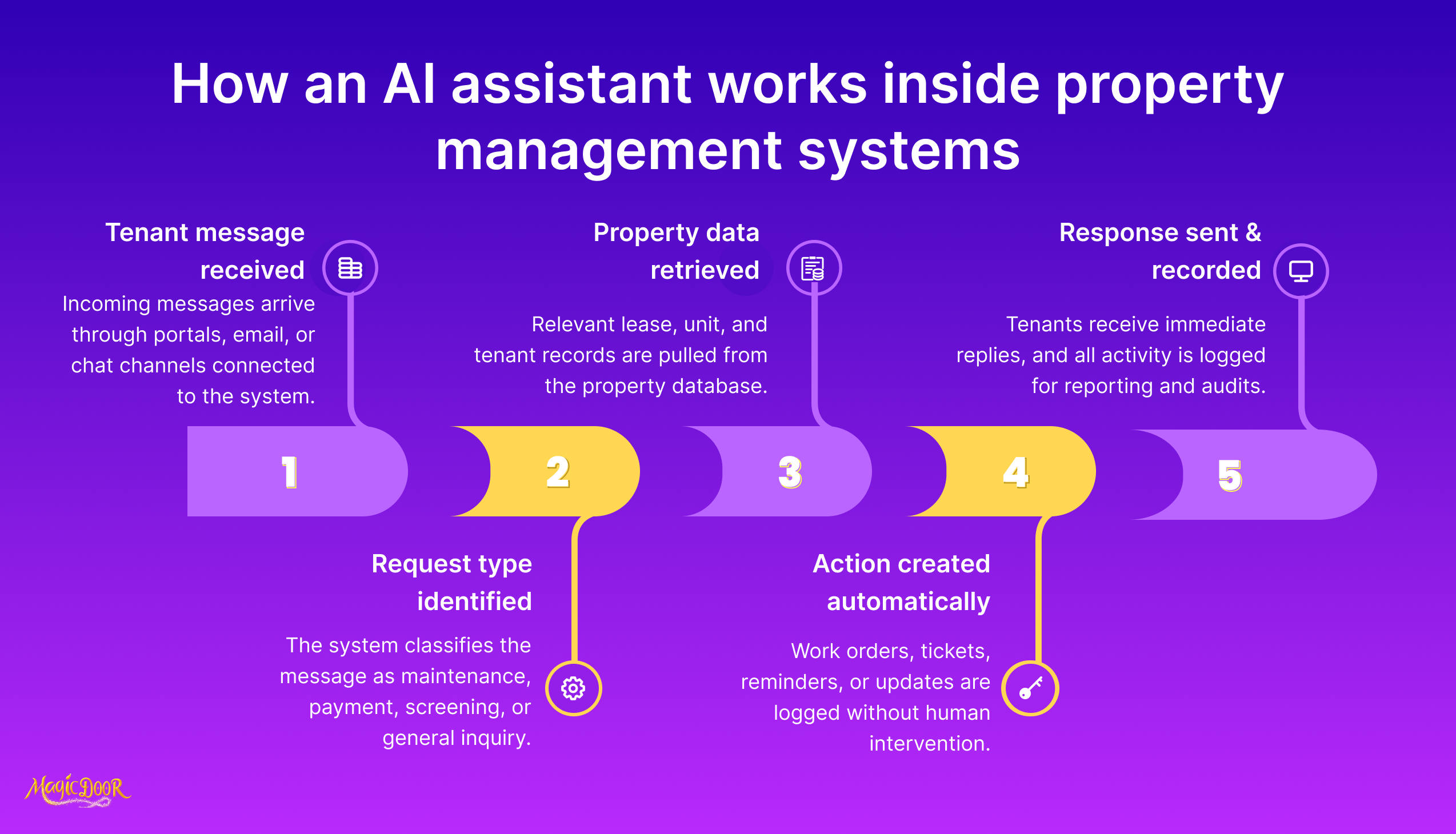
Fast responses reduce repeat messages and frustration. When tenants receive immediate responses to service requests or payment questions, support conversations are shorter and clearer.
Over time, that consistency improves tenant satisfaction without adding another full-time team member or expanding office hours.
AI assistants perform best when tasks repeat daily and follow clear logic. Typical examples include:
- Answering common tenant inquiries
- Sending rent reminders and lease renewal notices
- Logging service requests and maintenance updates
- Recording compliance-related actions
- Handling structured data entry tasks
Situations involving disputes, sensitive conversations, or sensitive information still belong with a real person. AI focuses on the heavy lifting: volume, speed, and consistency.
Automating communications with tenants through AI agents minimizes human error and ensures compliance with property regulations. Skilled staff and skilled virtual assistants stay focused on judgment-based work rather than repetitive requests.
What is a Virtual Assistant For Property Managers?
A virtual assistant in property management is a remote professional who helps keep daily work moving when inboxes start to pile up. Property managers usually bring one on board to support tenant conversations, leasing admin, and routine updates that need a human voice.
Picture a busy weekday. Tenants ask about lease terms. Someone wants an update on a repair. Another renter needs help with screening paperwork.
A property management virtual assistant steps in to answer messages, log details, and keep records up to date while the manager focuses on decisions that actually need experience. Also, virtual assistants can be trained to handle payments, invoicing, and financial reporting tasks.
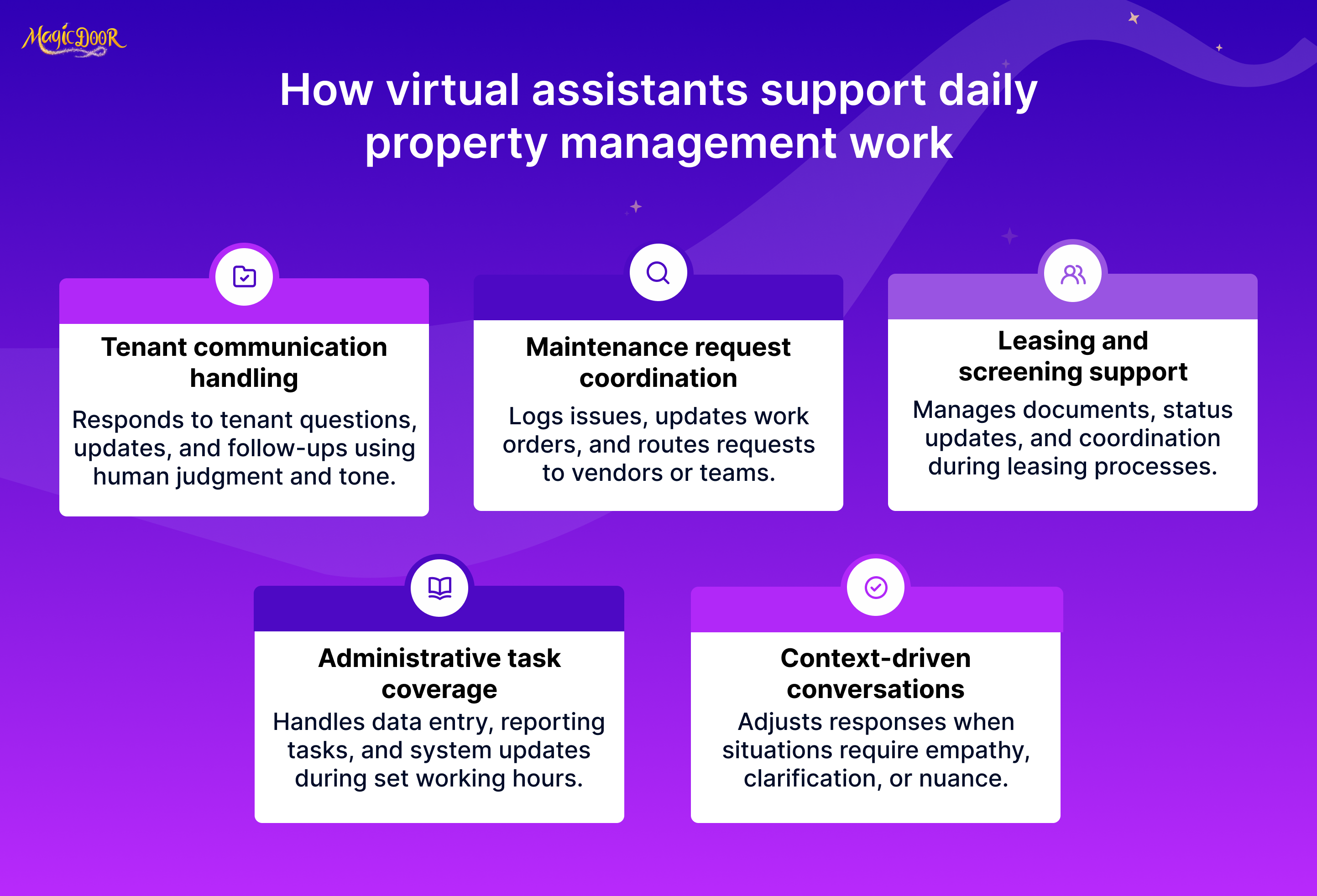
Most virtual assistants work set hours and follow clear instructions. Many come from agencies or freelance networks rather than hiring locally, which opens access to virtual professionals familiar with real estate workflows. Some teams rely on coverage from different time zones to extend availability without expanding office hours.
A virtual assistant’s daily work for property managers includes:
- Responding to tenant inquiries through email, portals, or messaging tools
- Logging maintenance requests and routing service requests to the right vendor or team
- Creating and updating work orders with notes, photos, and status changes
- Managing follow-ups so that open issues do not delay
- Supporting tenant screening steps, such as document collection and status updates
- Tracking lease renewals and updating lease-related records
- Handling structured data entry inside existing property management systems
Human involvement changes the tone of communication. A real person can read context, adjust language, and pick up on nuance when conversations drift away from simple requests.
Many property teams pair virtual assistants with automation and AI-powered tools. In that setup, AI handles repetitive work, while virtual assistants focus on communication that benefits from empathy and context.
Hiring virtual assistants can reduce overhead costs for property management businesses. The balance depends on volume, complexity, and the amount of human judgment the operation needs day to day.
What's The Difference Between an AI Assistant & a Virtual Assistant in Property Management?
| Comparison Area | AI Assistant | Virtual Assistant |
|---|---|---|
| Primary role | Executes rule-based tasks automatically | Performs tasks manually with human judgment |
| Type of work | Repetitive, structured workflows | Context-heavy, custom, or one-off work |
| Tenant communication | Immediate replies to common questions | Thoughtful replies that adapt to tone and nuance |
| Maintenance requests | Logs requests and updates work orders automatically | Reviews details and coordinates manually |
| Response time | Instant, any time of day | Depends on schedule and availability |
| Availability | Always on | Limited to working hours |
| Handling message volume | Same performance at any scale | Requires more hours or additional hiring |
| Accuracy style | Consistent rule execution | Varies by person and workload |
| Manager involvement | Set-up and occasional review | Ongoing direction and oversight |
| Scaling support | No added staffing needed | More people needed as volume increases |
| Best fit for | High-volume, predictable operations | Situations needing interpretation or flexibility |
Which Tasks Suit Automation Versus Human Judgment?
In property management, task type determines fit.
An AI assistant works best where rules stay consistent, and volume stays high. Examples include routing maintenance requests, logging service requests, creating work orders, sending rent-related updates, and managing structured tenant communication inside existing systems. AI agents follow predefined logic, which keeps execution fast and predictable for repetitive workflows.
Human judgment enters when context changes. Virtual assistants, including a property management virtual assistant, handle conversations that involve interpretation, tone, or exceptions.
Lease discussions, tenant screening reviews, renewal conversations, and nuanced tenant support usually benefit from a real person who can read intent and adjust responses. Human virtual assistants and other virtual professionals bring flexibility that software cannot replicate when information arrives incomplete or emotionally charged.
For a growing property management business, the division usually looks like automation for structured work and people for judgment-based communication. For example, AI predicts which tenants are at risk of falling behind on payments up to six months in advance, allowing for proactive payment plans.
Clear task boundaries keep both roles effective without overlap or confusion.
How Do Response Time & Availability Differ?
Response speed separates property management automation from human support immediately.
An AI assistant replies the moment a tenant submits a request. Messages arrive, logic triggers, and updates post automatically, regardless of hour or volume. No schedules, no coverage gaps, and no time-zone dependency. That consistency supports steady communication across all properties, even during peak demand.
Virtual assistants operate within defined working hours. Availability depends on schedules, workload, and location. Teams coordinate coverage across different time zones or rely on handoffs to maintain responsiveness.
While a property management virtual assistant can deliver thoughtful replies, response timing still depends on human capacity and coordination.
For teams managing many tenants and frequent requests, automation keeps response times predictable. Human support remains valuable where timing flexibility matters less than clarity and context.
What Does The Cost Model Look Like Over Time?
Cost differences become clearer as a property management operation grows. An AI assistant usually runs on a fixed software fee tied to usage, units, or message volume. Pricing remains predictable because the system handles repetitive tasks through automated workflows, regardless of how many service requests or tenant messages arrive.
No added cost appears when volume spikes, and no extra expense shows up during busy seasons.
A property management virtual assistant follows a labor-based model. Monthly costs depend on hours, scope, and experience level. Scaling support often requires additional hiring, onboarding time, and longer-term commitments.
Many teams also factor in coordination time and quality checks to ensure accuracy, since output depends on individual performance.
Over time, AI-powered systems absorb growth with fewer cost swings. Human virtual assistants add value to work that requires judgment, yet expenses rise in step with workload and headcount. The difference becomes more visible as portfolios and communication volume expand.
How Much Manager Involvement Does Each Option Require?
Manager time varies sharply between automation and human support.
An AI assistant runs based on predefined rules once configured. After setup, the system processes tenant communication, routes requests, and updates records with minimal oversight. Occasional reviews focus on data quality and logic updates rather than daily supervision.
Virtual assistants require regular coordination. Managers assign work, review responses, and clarify edge cases.
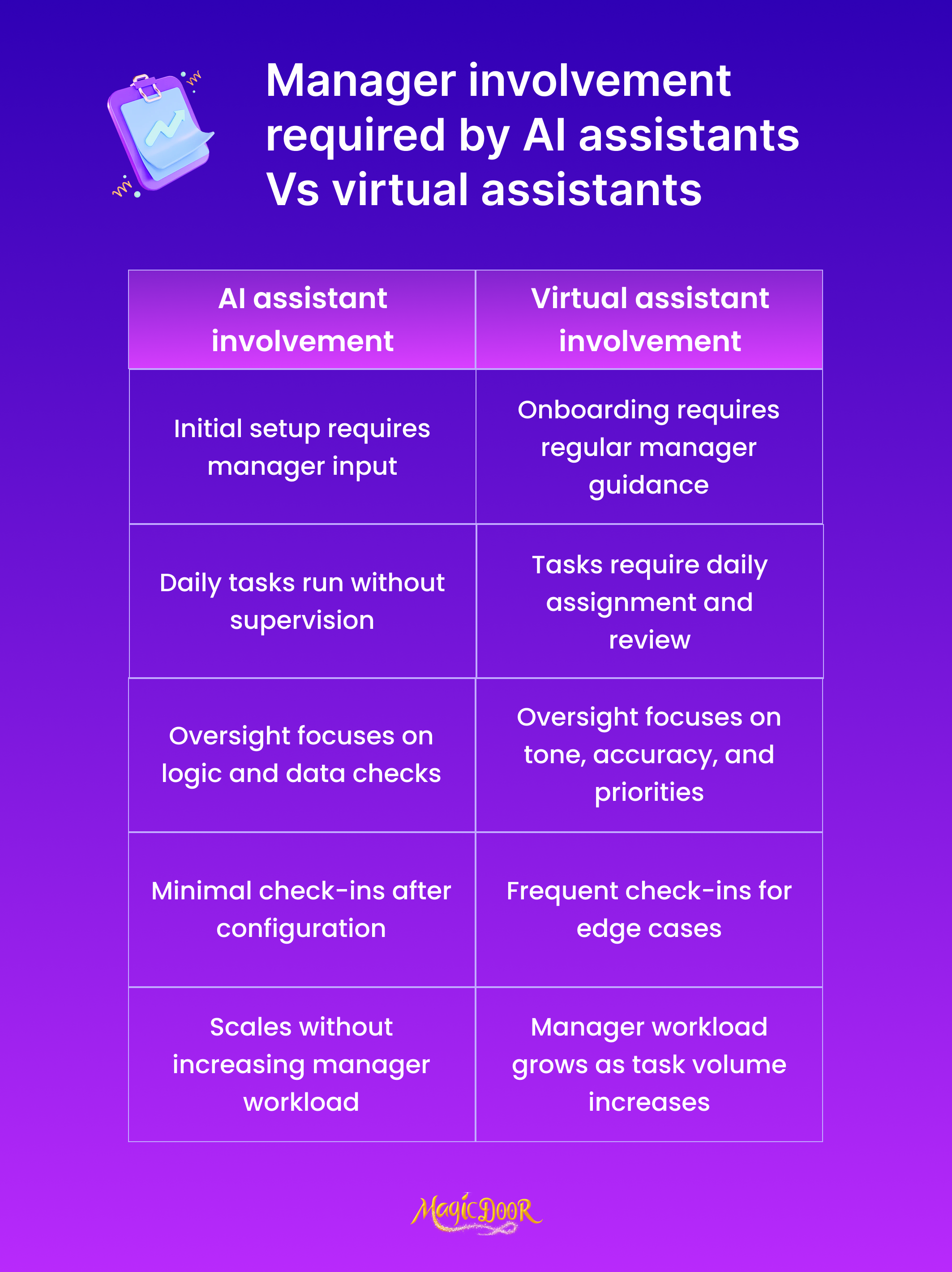
A property management virtual assistant usually checks in for direction on new scenarios, shifting priorities, or unusual tenant requests. Ongoing involvement increases during onboarding, performance reviews, or workflow changes.
For teams aiming to reduce hands-on oversight, AI tools lower daily involvement after initial configuration. Human support fits better when managers prefer direct control over conversations and task execution, even when that control demands more time and attention.
How Does Each Option Handle Message Volume as Portfolios Grow?
Portfolio growth shows up first in the inbox.
More tenants mean more questions, more service requests, more follow-ups. Volume does not increase neatly. Messages arrive in bursts, often at the same time, often about similar issues.
An AI assistant in property management quietly absorbs that pressure. Incoming messages trigger predefined logic. AI agents categorize requests, respond, log data, and move on to the next message.
Volume changes do not require staffing plans or coverage discussions. The system keeps pace because message handling does not depend on availability.
With virtual assistants, growth introduces friction. More messages require more hours. More hours lead to more hiring. Coordination becomes part of daily work, particularly when support comes from different regions or when hiring locally is required. Without careful planning, response queues grow faster than headcount.
Large real estate portfolios usually feel this difference early. Automation absorbs spikes. Human capacity expands step by step.
Where Do Accuracy & Consistency Break Down?
Consistency starts with rules.
An AI assistant applies the same logic to every request. Data moves through the same paths, records update the same way, and responses follow the same structure. Clean input leads to clean output. Problems usually trace back to unclear rules or missing data rather than execution drift.
Human work behaves differently. Virtual assistants interpret information before responding. Interpretation adds flexibility, yet variation creeps in during busy periods. Missed follow-ups, uneven phrasing, or inconsistent data updates become more likely as volume increases or workloads change.
Accuracy improves when boundaries stay clear. Automation keeps structured work predictable. Human support shines when information arrives incomplete or requires judgment. Mixing the two without clear roles introduces inconsistency faster than either option alone.
When an AI Assistant Makes More Sense for Property Managers
High Volume Tenant Messaging
Large portfolios generate steady message traffic. Rent questions, repair updates, access instructions, and status checks arrive constantly, repeatedly saying the same thing in slightly different ways.
The pressure comes from repetition, not complexity.
An AI assistant in property management fits best when tenant communication follows known patterns. AI-powered solutions reply instantly, categorize incoming service requests, trigger follow-ups, and log activity without waiting for staff availability. Message volume can increase without creating delays or adding overhead through new hiring.
Typical situations where automation carries the load well include:
- Rent and payment-related questions
- Maintenance request confirmations
- Status updates on open service requests
- Policy reminders and notice delivery
- Repeated tenant inquiries with clear answers
- Follow-ups on unresolved issues
Virtual assistants can manage tenant messages, yet response capacity depends on working hours and queue size. As volume grows, managers often adjust schedules or add staff to maintain response times. Automation removes that dependency when communication stays predictable.
After-Hours & Weekend Coverage
Tenant communication does not stop at the end of the workday. Messages arrive late at night, early in the morning, and throughout the weekend, often tied to urgent maintenance or access issues.
An AI assistant is always available.
Requests receive immediate acknowledgment, service requests get recorded, and next steps move forward without delay. Coverage remains consistent because the response does not depend on schedules, changes, or location.
With virtual assistants, extended coverage requires planning. Some teams rely on offshore support. Others rotate staff or stagger hours. Each option works, yet coordination becomes part of daily management, especially when urgent messages arrive outside standard office hours.
For real estate teams that want dependable availability without expanding schedules or adding complexity, AI-powered support keeps tenant communication active at any hour without manual management.
Repetitive Administrative Requests
Administrative requests pile up quietly. Address changes, document copies, confirmation messages, status checks, and basic updates all land in the same queue. None of the work is difficult. The volume is the problem.
An AI assistant in property management fits well here because the requests follow known rules. Automated workflows can read incoming messages, pull the right record, log updates, and reply with accurate information every time. No backlog forms when requests arrive in waves, and no staff time gets pulled away from higher-value work.
Common administrative requests suited for automation include:
- Payment confirmation messages
- Document re-sends and policy acknowledgments
- Status checks on open service requests
- Record updates tied to tenant or unit data
- Routine follow-ups after system-triggered notices
For teams spending hours each week on repetitive admin work, automation removes friction without adding new coordination layers.
Rent, Maintenance, & Policy Questions
Most tenant questions fall into familiar categories. When is rent due? Where does a maintenance update stand? What does the policy say about access, pets, or notice periods?
An AI assistant responds well in these cases because the answers are already stored in the system. Rent schedules, maintenance timelines, and policy rules stay consistent across properties. AI-powered logic pulls the right information, responds clearly, and records the interaction for future reference.
As message volume grows, automation keeps replies accurate and timely. AI chatbots provide 24/7 support, offering instant responses to inquiries about lease terms or maintenance, which can increase lead-to-lease conversion rates by 30% or more.
No delays occur during busy periods, and no dependencies form around staff availability. Predictive maintenance identifies potential equipment failures before they occur, reducing emergency repair costs by up to 20% and extending the lifespan of building systems like HVAC and elevators by up to 40%.
Communication stays predictable for tenants and easier to supervise for managers.
Growing Portfolios With Lean Teams
Portfolio growth changes workload faster than staffing plans.
More units mean more tenants, more questions, and more requests, even when the team size stays the same.
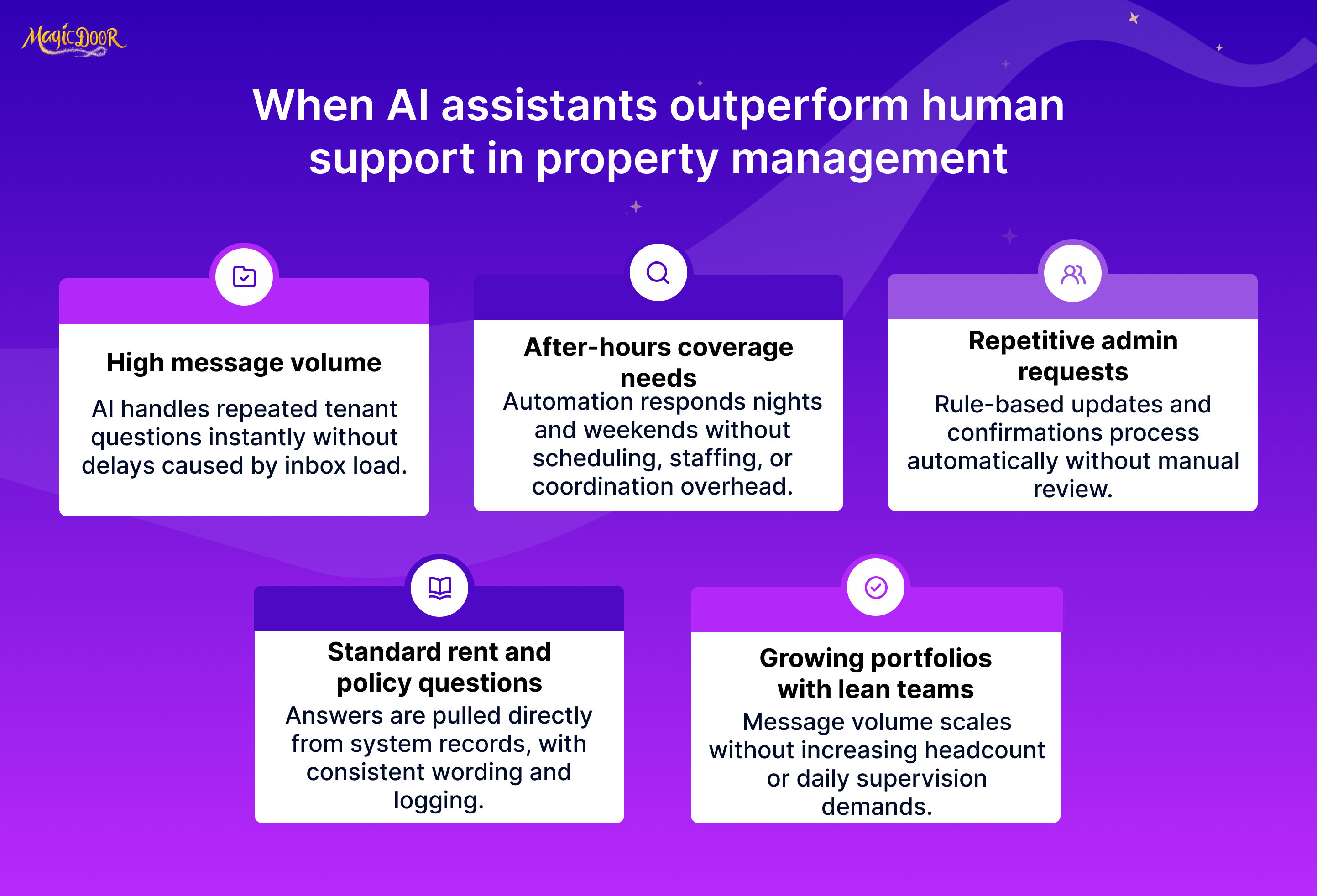
An AI assistant in property management supports lean teams by absorbing volume without adding headcount. Message routing, follow-ups, and routine updates continue at the same pace as the portfolio expands. Growth does not force immediate hiring, and daily operations stay steady rather than reactive.
Lean teams benefit most when automation covers predictable work, and people focus on judgment-based decisions.
When a Virtual Assistant is the Better Fit
Complex Tenant Conversations
Some tenant conversations do not follow scripts. Emotions run high. Details arrive out of order. One message references three past issues and an exception from last year. Automation struggles here.
A virtual assistant fits better when conversations require interpretation, patience, and judgment. A real person can read tone, ask clarifying questions, and adapt language mid-conversation. That flexibility helps when tenants raise complaints, dispute charges, or report maintenance issues that do not cleanly map to predefined categories.
Situations where human judgment adds value include:
- Complaints that mix multiple issues
- Disputes over charges or notices
- Emotional conversations after service delays
- Requests that fall outside the written policy
- Back-and-forth clarification over several messages
AI handles structure well. Human support handles nuance. For tenant conversations that wander, escalate, or require careful wording, virtual assistants keep communication grounded and constructive.
Owner Communication That Needs Context
Owner communication rarely stays transactional. Questions often come with history, preferences, and expectations shaped by past decisions.
A short update rarely covers everything an owner wants to know.
A property management virtual assistant brings continuity to those conversations. Context carries over from one exchange to the next. Prior approvals, cost sensitivities, and communication style stay top of mind. That continuity helps avoid misunderstandings and reduces the need for repeated explanations.
Virtual assistants also help when owners want explanations rather than status updates. Budget concerns, repair decisions, or lease changes benefit from human framing rather than automated summaries. The conversation feels deliberate, not mechanical.
For property managers balancing tenant needs and owner expectations, human support keeps communication aligned with relationships.
Custom One-Off Tasks
Some work does not repeat and does not follow a template. A city asks for a special form. A vendor needs a custom summary. An owner wants a report formatted a certain way for a one-time review.
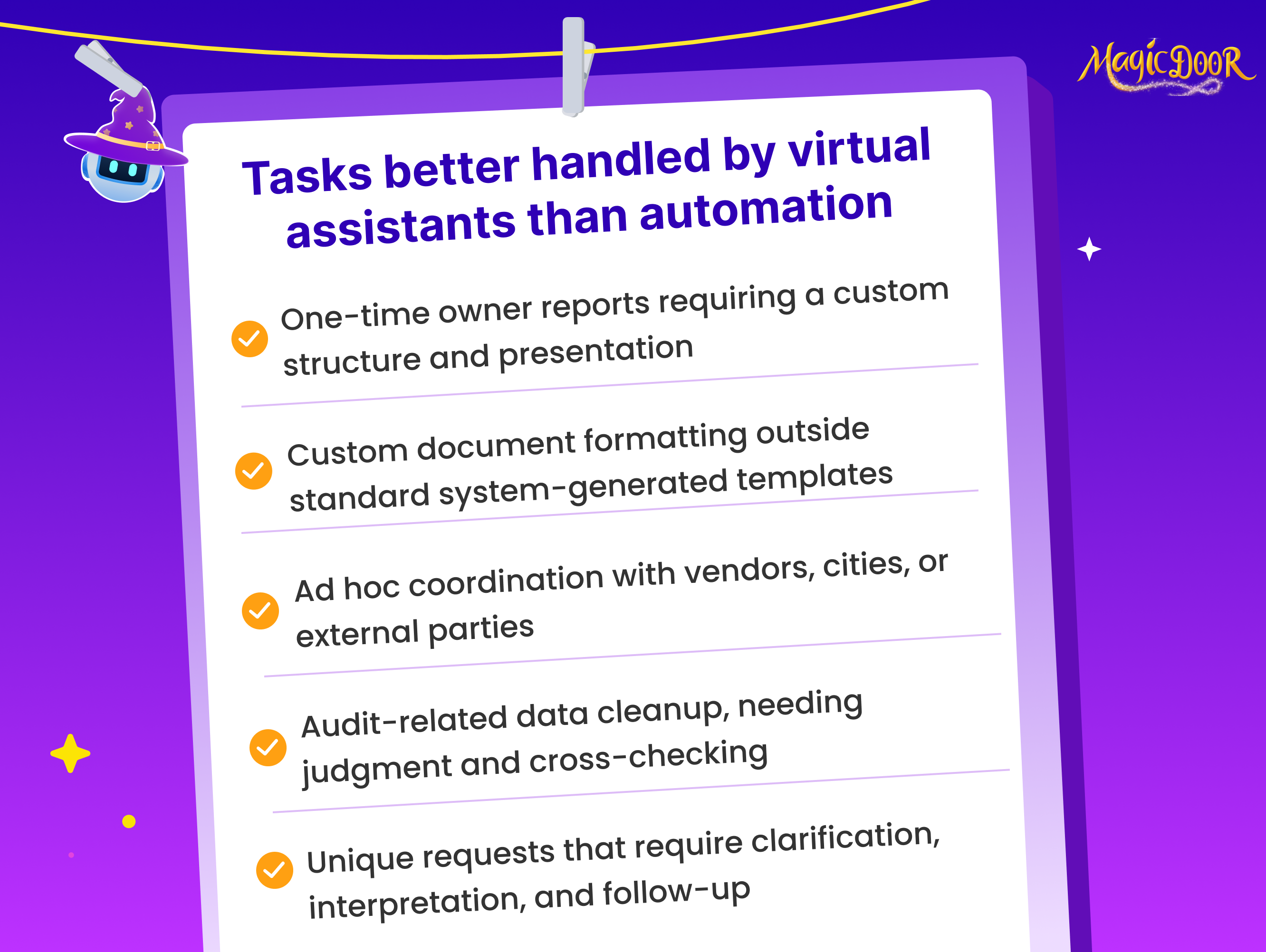
A virtual assistant fits these situations because a real person can interpret instructions, ask clarifying questions, and adjust output on the fly. Custom tasks involve judgment, formatting choices, or cross-checking details that do not neatly fit within a system. Human input keeps these tasks moving without forcing rigid rules where none exist.
Examples that benefit from human execution include:
- One-time reports requested by owners
- Custom document preparation or formatting
- Ad-hoc coordination with vendors or municipalities
- Special data cleanup tied to audits or transitions
For work that shows up once and disappears, flexibility matters more than speed.
Leasing Support That Requires Human Follow-Up
Leasing rarely follows a straight line. Prospects ask questions, disappear, return days later, and negotiate details that change mid-conversation.
A virtual assistant supports leasing when follow-up depends on context rather than timing alone. Human support can track conversations, remember prior objections, and respond with language that feels personal rather than scripted. That helps during application reviews, screening conversations, and lease discussions that move back and forth over time.
AI handles structured steps well. Leasing follow-up benefits from a human who can adapt when prospects hesitate, ask nuanced questions, or need reassurance before moving forward.
Small Portfolios With Irregular Workloads
Not every portfolio runs at a steady pace. Smaller operations often see quiet weeks followed by sudden bursts of activity. Automation built for volume may sit idle for long stretches.
A virtual assistant works better when the workload fluctuates. Managers can adjust hours, scope, and priorities without committing to full-time coverage. Support expands when needed and pulls back when activity slows, without reconfiguring systems or workflows.
For property managers overseeing a limited number of units, human support offers flexibility without locking the business into fixed usage patterns.
AI Assistant vs Virtual Assistant: Cost Comparison for Property Managers
Cost questions usually surface early, yet the real difference only shows up over time. Upfront pricing rarely tells the full story. Labor scales one way. Software scales another. The difference becomes clearer as message volume, properties, and operational pressure increase.
Below is a side-by-side comparison of how each option affects budgets in day-to-day property management.
| Cost Factor | AI Assistant | Virtual Assistant |
|---|---|---|
| Monthly cost range | Flat software fee or usage-based pricing tied to units, messages, or workflows | Hourly or monthly labor cost based on assigned hours and scope |
| Cost per task vs fixed labor cost | Cost stays stable even as repetitive tasks increase | Cost increases as task volume increases and more hours are required |
| Hidden costs managers miss | Initial setup time and workflow configuration | Hiring time, onboarding, supervision, rework, and coverage gaps |
| How costs change as portfolios expand | One system supports more properties with minimal pricing change | Growth usually requires additional hiring and ongoing coordination |
AI assistants change the cost away from labor and toward predictable system usage. Message spikes, follow-ups, and repetitive work do not increase expenses once automation is in place. Budget planning becomes simpler because volume no longer drives staffing decisions.
Virtual assistants follow a labor curve. More tenants lead to more work, which leads to more hours or additional hires.
Costs increase gradually rather than suddenly, yet long-term spending increases alongside portfolio growth. Oversight time often grows as well, even when hourly rates stay flat.
For teams planning expansion, the difference rarely shows up in the first month. It shows up later, when volume rises, and staffing decisions start shaping margins more than software fees.
Can Property Managers Use Both at the Same Time?
Yes, and plenty of property managers already run a mixed setup. AI can save an average of 10 hours per week for each property management employee by automating routine workflows.
The combo works when each option owns a different type of work. AI handles high-volume, rules-based communication. A virtual assistant takes care of requests that need context, judgment, and a human voice.
Once responsibilities are clear, the system feels simple rather than messy.
Start with AI as the “front line” for routine tenant communication. AI can respond to common questions, log service requests, trigger follow-ups, and keep records up to date within existing systems. That coverage helps during busy periods because tenant inquiries still get a fast response, even when the team is in the field.
Then use a virtual assistant for everything that benefits from interpretation.
Owner communication constantly needs background and careful wording. Leasing follow-up also fits well with a real person who can keep a prospect warm, answer nuanced questions, and adjust messaging based on the conversation. Custom one-off tasks land here too, since a virtual assistant can adapt without forcing strict rules.
Clear ownership prevents confusion. AI should not “share” the same thread with a virtual assistant unless escalation is planned.
A simple handoff rule keeps both sides effective: AI handles routine requests end to end, and a virtual assistant takes over when the situation changes, the request falls outside policy, or the conversation turns sensitive.
A practical division looks like this:
- AI replies to common tenant inquiries and routes service requests
- AI sends rent-related updates and tracks follow-ups
- A virtual assistant manages leasing conversations and screening coordination
- A virtual assistant handles owner updates that require context and judgment
In 2026, AI assistants have become essential for property managers to maintain a competitive edge, providing significant gains in speed, cost savings, and resident satisfaction. Used together, AI reduces volume and admin load, while a real person keeps relationships and edge cases handled with care.
Common Mistakes Property Managers Make When Choosing Assistants
Choosing between an AI assistant and a virtual assistant often feels straightforward at first. The problems usually show up later, once message volume increases, edge cases appear, or the portfolio changes shape. Most missteps come from unclear expectations about what each option should actually do.
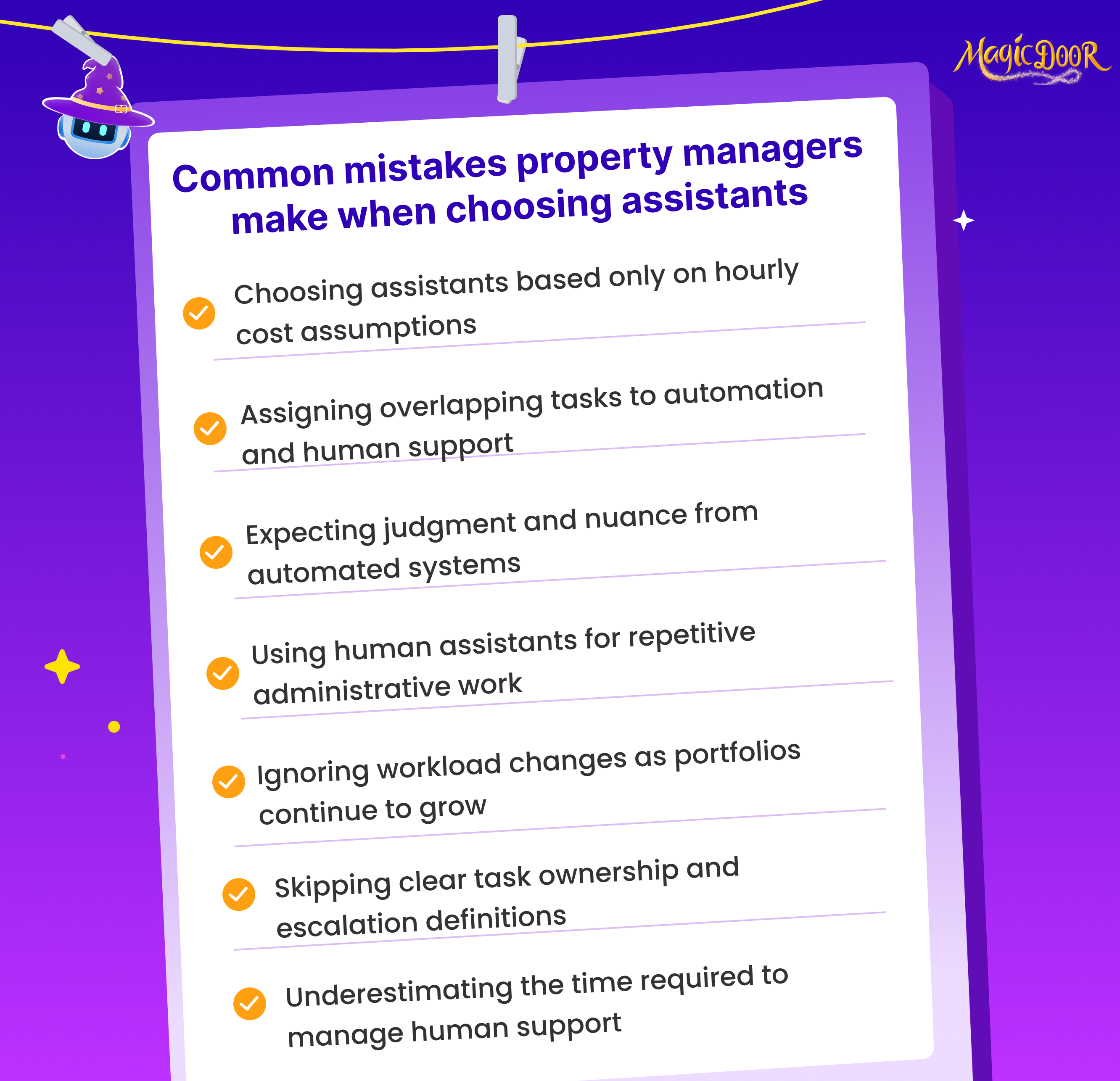
Here are the most common mistakes property managers run into:
- Choosing based on hourly cost alone
- Assigning the same tasks to both options
- Expecting judgment from fully automated systems
- Using human assistants for repetitive admin work
- Ignoring workload changes as portfolios grow
- Skipping clear task ownership and escalation rules
- Underestimating oversight time for human support
Cost-only decisions often overlook the time spent supervising, correcting work, or reassigning tasks. A lower hourly rate can still lead to higher effort if responsibilities stay unclear or volume increases unexpectedly.
Overlapping responsibilities create confusion fast. When both an AI assistant and a virtual assistant touch the same tenant conversations or service requests, duplicate replies and missed updates become more likely. Clear ownership avoids that friction.
Another common issue appears when teams expect automation to interpret distinctions.
AI performs well with structure and rules. Situations involving judgment, explanation, or emotional context belong with a real person. Mixing those expectations usually leads to frustration.
On the other side, assigning repetitive admin work to human assistants limits efficiency. Tasks like logging requests, sending routine updates, or tracking follow-ups consume time without using judgment.
Finally, many teams underestimate the level of involvement human support requires. Virtual assistants need direction, feedback, and ongoing coordination. Planning for that time upfront leads to better results and fewer surprises later.
Avoiding these mistakes starts with one simple step: define responsibilities clearly before choosing tools or people.
Once roles remain distinct, both options deliver value without stepping on each other’s toes.
Why MagicDoor Goes Beyond AI Assistants & Virtual Assistants
Most tools labeled as “AI” stop at conversation. They answer questions, route messages, or draft replies. Virtual assistants bring human judgment, yet still depend on handoffs, instructions, and availability.
MagicDoor sits in a different category.
MagicDoor is property management software built to execute work, not assist around it. The platform connects communication, payments, maintenance, leasing, and records into a single system. Tasks move forward automatically because the software owns the workflow end-to-end.
Instead of responding and waiting, MagicDoor acts.
When a tenant submits a maintenance request, the platform logs the issue, creates the work order, updates the status, and maintains the record. When rent is due, reminders go out, payments post, and follow-ups trigger based on actual outcomes. No prompts. No manual routing. No second system required to finish the job.
That difference changes how teams operate.
What sets MagicDoor apart
- Execution, not assistance: Tasks are completed inside the system rather than stopping at a reply
- Connected workflows: Communication links directly to payments, maintenance, and leasing records
- Clear ownership: Each task lives in one place with a defined outcome
- Built-in automation: Routine work moves forward without supervision
- One source of truth: Property data, messages, and updates stay aligned
AI assistants focus on conversation. Virtual assistants focus on support. MagicDoor focuses on outcomes.
For property managers, that means fewer tools, fewer handoffs, and fewer decisions about who should do what next. The platform removes busywork by design, so teams spend time on judgment-based decisions rather than task routing.
Conclusion
AI assistants and virtual assistants solve different problems. One handles volume and structure. The other brings judgment and context. Many property managers need both, but without extra tools or coordination headaches.
That’s where MagicDoor comes in.
MagicDoor runs workflows end to end, combining automation with real-world execution in one system. Start using MagicDoor to cover routine work automatically while keeping human judgment where it belongs.