Signs It's Time to Stop Managing Rental Properties on Spreadsheets
Get expert property management insights, straight to your inbox.
Managing rental properties on spreadsheets is a reasonable starting point. It's free, familiar, and functional, right up until the moment it isn't.
The landlords who get into trouble aren't the ones who started with spreadsheets. They're the ones who kept using them after the portfolio grew, the tenant count climbed, and the admin work multiplied.
A system built for two units doesn't hold up at eight. And the signs that it's breaking down rarely arrive all at once, they accumulate quietly, in missed late fees, lost maintenance requests, and financial reports that take hours to produce.
Knowing how to manage a rental property at scale means recognizing when your current tools are creating more work than they're saving. This guide covers the specific signs that spreadsheets have passed their limit, and what the path forward looks like for independent landlords.
Why Landlords Start With Spreadsheets in the First Place
Spreadsheets make sense at the beginning. You have one or two units, a handful of transactions, and a system you already know how to use. A Google Sheet tracks rent. Another tab handles expenses. A third holds tenant information. It works, and it costs nothing.
Most landlords don't set out to build a property management system. They set out to collect rent and stay organized. A spreadsheet covers both.
You open it, type what you know, and move on. No contract, no learning curve, no monthly fee. For a first-time property owner managing one lease agreement, that's a reasonable starting point.
The problem shows up later. A rental business doesn't stay simple. More tenants means more lease dates, more maintenance requests, and more late payments to track. Rent collection that once took five minutes now requires cross-referencing three tabs and hoping nothing was entered twice.
Manual records don't send automated reminders. They don't flag which tenant is overdue or pull a rent roll in seconds. Every month becomes a small reconstruction project, finding the data, checking the data, correcting the data.
Spreadsheets weren't built for that volume. Most landlords figure that out only after the system starts costing them time they don't have.
When Spreadsheets Stop Working for Rental Property Management
Your Rent Tracking Spreadsheet Doesn't Scale Past a Few Properties
One unit, one row. Two units, two rows. The logic holds, until it doesn't.
At three or four properties, a rent-tracking spreadsheet starts to require real maintenance. New columns for each tenant, manual updates every time someone pays, separate tabs for different buildings. What started as a simple grid becomes a document you're afraid to touch in case something breaks.
Property managers handling 10 or more units often end up with multiple files that don't integrate with each other.
Rent collection data lives in one sheet. Lease agreements in another. Cash flow summaries somewhere else. Pulling a rent roll means opening four documents and hoping the numbers match.
The volume of admin tasks doesn't grow linearly. It compounds.
No Central Rent Payment Tracker for All Your Tenants
When tenants pay through different methods, bank transfers, checks, cash, online payments, tracking it all in one spreadsheet becomes a manual job in itself. You're logging each payment individually, checking it against the right tenant, and updating the right cell.
Miss one entry, and your records are wrong for the rest of the month.
There's no single view showing who has paid, who hasn't, and who is three days away from a late fee. You build that view yourself, every month, from scratch.
A spreadsheet holds data. It doesn't monitor it. The difference matters when you're managing multiple tenants and need accurate tenant information without spending an hour assembling it.
Late Fees Get Missed Without Automated Rent Tracking
Late rent is only a problem if you catch it on time.
Spreadsheets don't flag overdue payments. They don't send automated rent reminders. They don't calculate fees based on your lease terms.
You do all of that manually, which means late fees get missed when you're busy, when a payment looks right but wasn't recorded, or when a due date falls on a weekend and your tracking slips by a day.
For a rental business running on tight cash flow, a missed late fee isn't just an inconvenience. It's a signal to tenants that the policy isn't enforced consistently. Automated rent collection removes that inconsistency entirely. The system tracks the date, applies the fee, and logs it without requiring you to remember.
Lease Renewals Catch You Off Guard Every Time
A lease end date sitting in a spreadsheet cell doesn't do anything. It doesn't alert you 60 days out. It doesn't remind you to contact the tenant. It just sits there until you happen to scroll past it, or until the lease expires and you're scrambling.
Most property managers running on spreadsheets have missed a renewal window at least once. The cost isn't always financial. Sometimes it's a good tenant who assumes silence means you don't care and signs elsewhere.
Lease management requires visibility into what's expiring, when, and what action is needed. A static sheet offers none of that.
Tenant Maintenance Requests Get Lost Before You Can Act on Them
Maintenance tracking in a spreadsheet depends entirely on you remembering to log it. A tenant sends a message about a leaking pipe. You note it somewhere. Then another request comes in, and another. By the time you check the sheet, one of them is two weeks old.
The requests that fall through aren't always the urgent ones. Sometimes it's the slow drip that becomes water damage. The HVAC issue that becomes a habitability complaint.
Dedicated maintenance-tracking software gives tenants a direct channel to submit requests, including photos, descriptions, and timestamps. Nothing arrives through a text message that gets buried. Nothing gets logged unless you remember to log it.
What typically gets lost in a spreadsheet-based system:
- Requests sent via text or email that never made it to the sheet
- Follow-up dates that weren't set
- Completed jobs with no record of cost or vendor
- Repeat issues at the same unit that look like isolated incidents
Pulling a Rental Income Report From Your Spreadsheet Takes Hours
Financial reports shouldn't be a project. But on a spreadsheet, they are.
To produce a basic income summary, you're pulling data from multiple tabs, checking figures against bank account records, recategorizing anything that was entered inconsistently, and then formatting it into something readable. That's before you account for any entry errors, and academic studies on error rates put error rates in manually maintained spreadsheets as high as 88%.
For a rental business preparing for tax season or reviewing cash flow mid-year, that's a real liability. An inaccurate financial report doesn't just waste time. It creates decisions made on wrong numbers.
Property management accounting software generates those reports automatically, including income, expenses, and owner statements, pulling from the same data used to record every transaction. The figures are consistent, categorized, and ready without spending hours verifying whether the numbers in column D match what actually cleared the bank.
What Happens to Landlords Who Wait Too Long to Switch to Property Management Software
Most landlords don't decide to stay on spreadsheets. They just don't decide to leave. The cost of that inaction accumulates quietly, until it doesn't.
Here's what that looks like in practice:
- Tenant retention drops: Late responses to maintenance requests, missed follow-ups, communication that falls through the cracks, tenants notice. Finding new tenants costs more than keeping good ones. Vacancy days, background checks, credit reports, tenant screening, that's time and money spent replacing someone who might have stayed.
- Cash flow reporting becomes unreliable: When financial data lives across multiple tabs updated manually, the numbers are only as accurate as the last person who touched them. Decisions about whether to acquire another property, adjust rent, or cut expenses are made on figures that may already be wrong.
- Compliance exposure increases. Lease agreements with missing renewal dates, untracked maintenance requests with no timestamp, sensitive data stored in an unprotected file; these aren't hypothetical risks. They're the predictable result of a system without an audit trail.
- Admin work expands to fill available time: Spreadsheets don't reduce admin tasks as a portfolio grows. They multiply them. Landlords managing properties on manual systems report spending 10 to 15 hours per month on data entry and tracking work that property management automation handles without human input.
The hidden cost isn't the spreadsheet itself. It's the hours spent maintaining it, the errors that go undetected, and the decisions made on incomplete data. Rental software subscriptions are usually less expensive than a single missed late fee or one vacant unit that sat two weeks longer than it needed to.
Waiting for the system to break completely before switching isn't a strategy. By that point, the cost of fixing it exceeds the cost of replacing it.
What Switching From Spreadsheets to Property Management Software Looks Like
The most common reason landlords stay on spreadsheets isn't cost. It's the assumption that switching means weeks of disruption, re-entering all the data, and learning a system from scratch.
For most small portfolios, that's not what the transition actually involves.
How Long Does the Transition Take for a Small Rental Portfolio
For landlords managing under 20 units, the move to rental management tools typically takes a few days, not weeks. Most rental property management software platforms are built with onboarding support and import tools specifically because spreadsheet migration is the most common starting point.
The process generally follows this order:
- Export your existing data: tenant information, lease agreements, rent payment history, and bank account records
- Import into the platform: most tools accept CSV files directly from Excel or Google Sheets
- Set up automated processes: online rent collection, automated rent reminders, and tenant communication channels
- Notify your tenants: explain how they'll pay rent going forward and where to submit maintenance requests
How you introduce the new system to tenants matters. A brief message explaining the change, the benefits of online payments, and what they need to do next removes most friction before it starts.
A phased approach works well for landlords managing multiple properties — start with rent collection and tenant communication, then layer in maintenance tracking and financial reports once the basics are running.
What Data Landlords Actually Need to Move Over
The goal isn't to transfer everything. It's to transfer what the software needs to run accurately from day one.
| Data Type | Why It Matters |
|---|---|
| Tenant names and contact details | Activates tenant communication tools and online payments |
| Lease start and end dates | Triggers renewal alerts and lease management tracking |
| Rent amounts and due dates | Powers automated rent collection and late fee calculations |
| Outstanding balances | Keeps financial reports accurate from the first cycle |
| Active maintenance requests | Prevents open issues from falling through during transition |
Sensitive data, credit reports, background checks, and tenant screening records should be migrated carefully and stored only within the platform's secure environment, not left in an open spreadsheet file.
A clean data import means automated reminders reach the right tenants, financial reports reflect accurate figures, and property managers don't have to correct errors in the first week of using the new system.
Why Landlords Managing Multiple Units Use MagicDoor Instead of Spreadsheets
At one or two units, spreadsheets are manageable. At three or more, the hidden costs start adding up: missed late fees, untracked maintenance requests, and financial reports built from inconsistent data. Property managers at that threshold need rental software that matches how their portfolio actually operates, not a grid that requires manual upkeep to stay accurate.
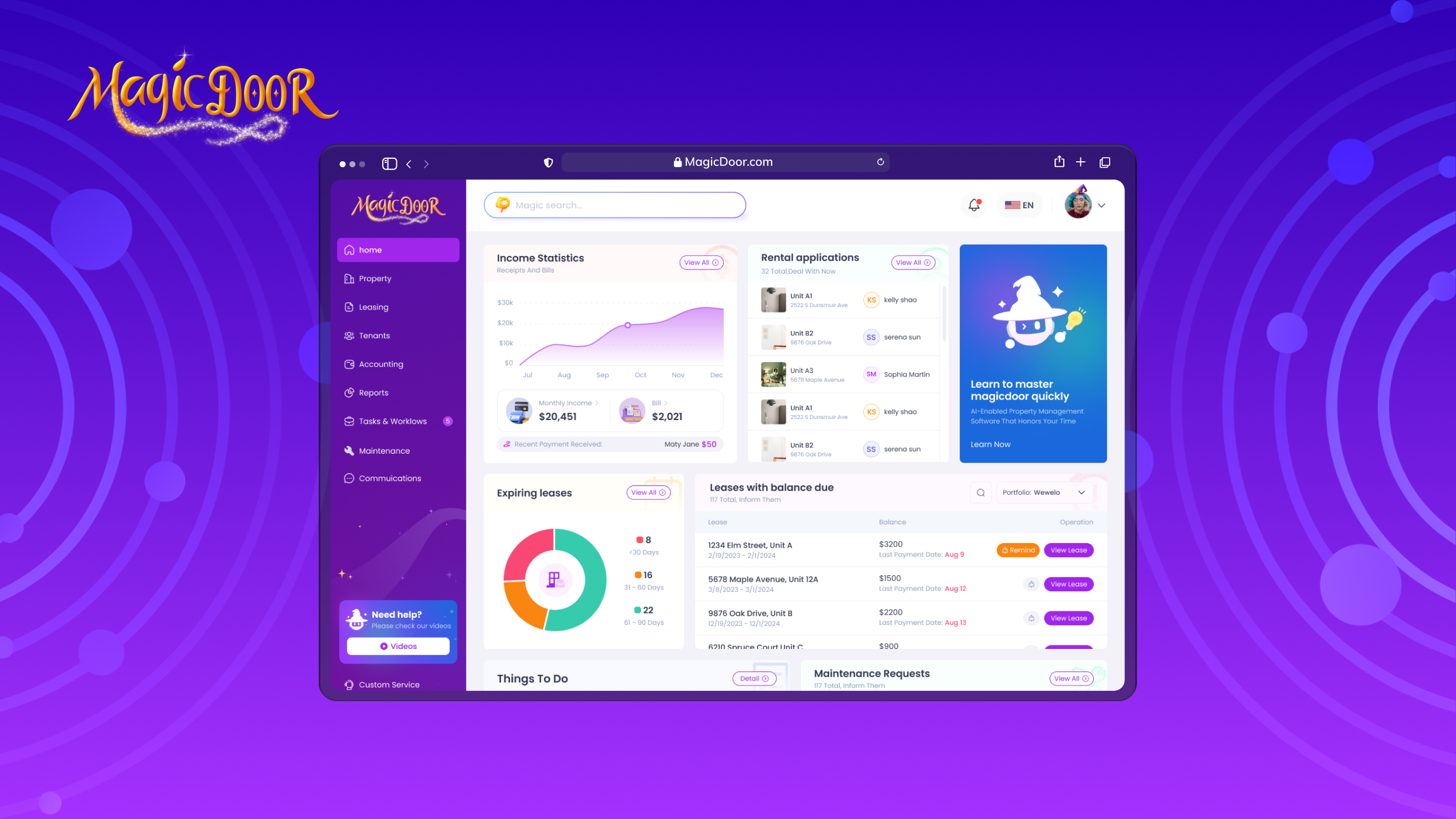
MagicDoor is built specifically for independent landlords and property managers who've outgrown spreadsheets but don't need enterprise-level complexity.
For landlords watching costs closely, MagicDoor's free rental management software covers all the functions most landlords need first: rent collection, tenant communication, and basic property management, without a subscription commitment before you've seen how it fits your workflow.
The key benefit isn't just replacing a spreadsheet. It's replacing the admin work that surrounds it.
Landlords switching to MagicDoor recover an average of 10 to 15 hours per month previously spent on manual data entry, payment tracking, and maintenance logging.
A few specifics worth knowing before evaluating other tools:
- Rent collection runs through the platform, tenants pay online, records update automatically, and late fees apply based on your lease terms
- Maintenance requests come through a dedicated tenant portal with photo and video submissions, so nothing arrives through a text thread you'll lose later
- Financial reports pull from live transaction data, not a spreadsheet you've been updating since January
- Tenant communication is logged in one place, no scattered emails, no missed messages
For landlords managing properties across multiple units, the right property management software isn't about finding the most feature-heavy platform. It's about finding one that solves the specific problems spreadsheets create, and is straightforward enough that both you and your tenants can use it from day one.
Facilitate tenant management and automate your accounting without rebuilding your entire process from scratch.
Conclusion
Spreadsheets aren't the problem. Holding onto them past the point where they're costing you time, accuracy, and tenant trust, that's the problem.
If more than a few of the signs in this guide looked familiar, the difference between your current system and a better one is smaller than it seems. Most landlords managing three or more units find that transitioning to property management software takes days, not weeks, and that the AI tools replacing manual property management tasks they were skeptical about are the same ones that stop the 11 pm spreadsheet corrections for good.
The admin work doesn't have to expand every time your portfolio does. Automated rent collection, centralized tenant records, and accurate financial reports aren't features reserved for large operators. They're available now, on a platform built for exactly the portfolio size you're managing.
If the spreadsheet is still open, it's worth asking how much it's actually costing you in time, errors, and decisions made on data you're not fully sure is right.
Try MagicDoor, a free property management software, and see what your rental business looks like when the system runs itself. Check out our pricing page to see more plans.