What to Look For in Owner Statement Software For Property Managers
Get expert property management insights, straight to your inbox.
Owner statement software makes how property managers report performance, communicate financial results, and maintain trust with clients. If reporting feels manual, inconsistent, or difficult to explain, the issue usually sits in the system behind the statements.
This guide breaks down what to look for in owner statement software for property managers, covering templates and automation, trust accounting, integrations, and owner portal access. You’ll see which features protect financial accuracy, which ones support growth, and which mistakes quietly create long-term problems.
If you manage rental properties and want reporting that supports operational control and financial clarity, this article will help you evaluate your options with confidence.
What is Owner Statement Software in Property Management?
Owner statement software is a specialized part of property management software that generates structured financial reports showing how a rental property performed over a specific date range.
In property management, an owner statement is a report sent to property owners that summarizes income and expenses for a reporting period, usually monthly. The software automates the creation of owner statements using financial data already recorded in the system.
The system pulls information directly from:
- Rent payments
- Late fees
- Maintenance and repair expenses
- Property taxes
- Management fees
- Other recorded expenses
- Bank records tied to the property
Owner statements typically include total rental income, a breakdown of income and expenses, and the final net income or net cash flow for the statement period. That structure gives rental property owners visibility into the property’s financial performance without requiring them to review raw accounting entries.
Because the data comes from rent collection records, payment records, and expense tracking inside the platform, the generated statements reflect actual transactions tied to the rental property.
Most owner statement software connects to an owner portal, where owners access monthly statements, past statements, and financial reports online. This access reduces manual requests and gives property owners visibility into their rental business whenever needed.
Owner statement software helps manage owner statements efficiently, generate statements for a specific date range, and present organized financial information to support clarity for property managers and property owners.
Key Features to Consider in Owner Statement Software
| Feature | What it should do | Why it matters |
|---|---|---|
| Owner Statement Templates & Custom Branding | Provide customizable templates with structured sections for rental income, maintenance costs, property taxes, management fees, and final net income. | Prevents confusion, improves clarity, and ensures owner statements look professional and consistent. |
| Clear Income & Expense Breakdown | Use consistent categories for income expenses and clearly separate management fees from other expenses paid. | Helps property owners compare monthly owner statements and understand property performance without second-guessing totals. |
| Automated Income & Expense Allocation | Automatically assign rent collection, late fees, maintenance costs, taxes, and transfers to the correct property and owner. | Reduces manual errors and ensures accurate owner statements that reflect real financial activity. |
| Bank Reconciliation | Reconcile transactions with bank statements and accounting software. | Prevents discrepancies and protects the accuracy of financial data. |
| Trust Accounting & Owner Funds Tracking | Separate operating funds, security deposits, and owner balances while tracking distributions and reserves. | Maintains compliance and ensures property performance reports reflect true cash flow. |
| Transaction-Level Transparency | Record rental income, fees deducted, expenses paid, and owner distributions in structured reports. | Gives property owners visibility into financial health and strengthens reporting credibility. |
| System Integrations | Integrate with property management platforms, payment processors, and accounting systems. | Eliminates manual data entry and keeps owner statements consistent and repeatable. |
| Automated Statement Generation | Generate monthly owner statements automatically using recorded financial data. | Supports timely delivery and reduces reporting delays as portfolios grow. |
| Owner Portal Access | Provide 24/7 access to current and historical statements through an online portal. | Reduces email requests and improves transparency for property owners. |
| Secure Document Storage | Store financial reports and supporting documents inside the portal. | Protects records for audits, tax preparation, and long-term reference. |
Owner Statement Templates & Custom Branding
Templates define how financial information is presented to property owners.
Poor formatting doesn’t just look unprofessional, it can confuse property owners and create unnecessary questions about income and expenses.
Owner statement software should allow property managers to customize owner statements to match their property management company’s branding and reporting standards. That includes structured sections for rental income, maintenance tracking costs, property taxes, management fees, and final net income.
Using consistent categories for income expenses helps owners compare monthly owner statements without second-guessing what changed. Owners expect clarity. When categories move or totals appear without explanation, financial reports become harder to interpret.
A clean template should:
- Show total rental income and late fees clearly
- Separate property management fees from other expenses paid
- Highlight net cash flow and owner payout
- Include notes for unusual transactions
- Display property details and statement period visibly
Property management software can automatically generate consistent owner statements that look professional and are easy to share. Automated owner statements also support timely delivery, which matters more than most management companies realize. Sending inconsistent or late reports makes it harder for owners to track property performance.
Templates are not about aesthetics. They are about financial clarity and reducing friction in communication.
Automated Income & Expense Allocation by Property & Owner
Accurate allocation determines whether owner statements reflect reality or distort it.
Owner statement software pulls financial data directly from rent payments, invoices, receipts, and leases already tracked in the system. That data must be assigned to the correct rental property and the correct property owner without manual intervention.
Property management automation organizes income and allocates expenses at the property level, including:
- Rent collection and late fees
- Maintenance costs
- Property taxes
- Management fees
- Vendor payments
- Transfers to the owner’s bank account
When allocation is automated, monthly owner statements clearly show total rental income, categorized expenses paid, and final net income for the reporting period. Clean allocation supports accurate financial data and reliable owner payout calculations.
Reconciliation with bank statements adds another layer of control. Owner statement software should automate reconciliation with bank records to reduce discrepancies between accounting software entries and actual bank account activity.
Failing to record all expenses leads to inaccurate owner statements. Ignoring reconciliation weakens trust quickly. Even one misallocated transaction can distort a rental property’s financial health.
Automated allocation protects financial clarity and gives property owners a clear view of property performance without manual corrections behind the scenes.
Trust Accounting & Owner Funds Tracking
Trust accounting is not a side feature. For property managers, it is a legal and operational requirement.
Owner statement software should clearly separate operating funds, security deposits, and owner balances. Accurate owner statements depend on clean tracking of rental income, maintenance costs, management fees, and any transfers tied to a rental property. When funds are mixed or misclassified, property performance reports stop reflecting reality.
Strong systems track every movement that affects an owner’s balance:
- Rental income collected
- Management fees deducted
- Maintenance and repair expenses paid
- Owner distributions
- Reserve balances held for future costs
Each transaction should roll into structured owner statements that show income and expenses transparently. The final net income figure reveals what the property generated during the reporting period. That clarity protects both the property management company and the client.
Regularly reviewing owner statements helps property owners monitor their property’s financial health and understand how cash flow changes month to month. Monthly statements allow owners to analyze trends. Quarterly or annual reports support tax preparation and long-term planning.
Property managers should also keep records of every statement sent for audits and compliance reviews. Not backing up reports can complicate tax time and create unnecessary risk for management companies.
Trust accounting and owner funds tracking are about control. When cash flow is clearly documented and reconciled, accurate owner statements become predictable rather than stressful to produce.
Integrations With Property Management, Payments, & Accounting Systems
Disconnected systems create disconnected reporting.
Owner statement software should integrate directly with property management platforms, payment processors, and accounting software. Integration allows financial data to flow automatically from rent collection and expense tracking into owner statements without manual re-entry.
When systems communicate properly:
- Rental income posts automatically
- Maintenance costs sync from vendor bills
- Management fees calculate correctly
- Income expenses stay categorized consistently
- Net income reflects real activity
Owner statement software pulls financial data directly from rent payments and expenses recorded in the system. That integration supports accurate owner statements and reduces month-end reconciliation work.
Without proper integrations, property managers spend time cross-checking numbers between platforms. Manual adjustments increase the risk of errors, and inconsistent reporting weakens confidence in the property’s financial health.
Integrated reporting keeps creating owner statements structured and repeatable. Automated owner statements ensure consistency in reporting formats, making it easier for property owners to track financial performance over time.
For growing property management companies, integration is not a convenience. It is infrastructure.
Owner Portal Access & Document Delivery
Sending statements by email may work at small scale. Growth changes that quickly.
Owner statement software connects to an online portal, giving owners 24/7 access to financial reports and important documents from any device. Owner portals provide real-time access to financial data and performance metrics, reducing the need for back-and-forth communication.
Through the portal, property owners can:
- View current and historical owner statements
- Download monthly statements and quarterly or annual reports
- Review rental income and maintenance costs
- Access supporting documents tied to their rental property
Timely delivery of owner statements is essential to maintain trust and satisfaction among property owners. A centralized portal removes delays and creates a consistent experience.
Owner statements should be well-formatted and professional in appearance, reflecting the standards of the property management company. Transparency in owner statements builds confidence because owners see how income and expenses affect net income and cash flow in real time.
Monthly statements generated by property managers allow owners to track property performance over time. Annual statements provide tax-ready data when needed. Owner portals securely store financial reports, protecting records and simplifying future reference.
Clear access to organized information strengthens long-term relationships. When property managers provide structured reporting and easy document delivery, consistent reporting builds trust naturally.
Factors to Consider When Choosing an Owner Statement System
Portfolio Size Compatibility for Small & Large Property Management Firms
Portfolio size changes how property managers use owner statement software.
A small firm managing 20 units has different needs than a property management company overseeing 2,000 doors. The system you choose must handle your current volume without friction and support growth without forcing a migration six months later.
For smaller teams, simplicity matters. Creating owner statements should not require complex configuration or outside accounting work. Monthly reports need to be clear, accurate, and easy to generate. Overloading statements with unnecessary data can overwhelm owners who only want to see income expenses, property management fees, and their final payout.
For larger firms, scale and control are priorities. The platform must:
- Process high volumes of income expenses without lag
- Calculate property management fees automatically
- Generate monthly and annual statements in bulk
- Track net income per property and per owner
- Maintain detailed financial records for audits
As portfolios grow, reporting errors become more expensive. One incorrect allocation repeated across dozens of properties can distort net income at scale. Property managers should keep records of every statement sent to owners for future reference, compliance reviews, and tax preparation.
Growth also increases communication tool demands. Owner statement software that connects to an online portal gives owners 24/7 access to financial reports and important documents from any device. Owner portals securely store financial reports and reduce email traffic, both of which become critical as the number of clients increases.
Annual statements should provide tax-ready data, including 1099 forms where applicable. Monthly statements generated by property managers allow owners to analyze cash-flow trends and adjust investment strategies based on historical data.
A system that works for five properties but struggles at fifty will limit your operations. Portfolio compatibility is not about features on paper. It is about performance under real reporting volume.
Support for Multi-Entity Ownership & Trust Accounts
Ownership structures are rarely simple.
Some properties are owned by individuals. Others sit under LLCs, partnerships, family trusts, or investment groups. An owner statement system must handle multi-entity ownership without manual workarounds.
When multiple stakeholders share a rental asset, the software should:
- Split income expenses proportionally
- Allocate property management fees correctly
- Track net income per entity
- Maintain clear audit trails
- Separate operating funds from trust accounts
Trust accounting adds another layer. Funds held on behalf of owners must remain distinct from company operating balances. Clear tracking protects property managers from compliance risks and gives owners visibility into how funds are handled.
Owner statements typically include rental income, maintenance costs, property taxes, management fees, and the final net income. When multiple entities are involved, those categories must remain transparent and correctly assigned. Forgetting to include management fees or taxes gives owners an incomplete picture of returns, which damages credibility quickly.
Transparency in owner statements builds confidence among property owners regarding their investment management. A good owner statement is simple, visual, and structured, even when ownership structures are complex.
Owner portals provide real-time access to financial data and performance metrics. That access becomes more important when several stakeholders review the same reports. Regularly reviewing owner statements helps owners track income expenses, monitor cash flow, and evaluate overall financial performance.
Complex ownership should not require complex reporting. The right system keeps allocations precise, keeps trust accounts separate, and makes documentation accessible through a secure online portal.
Automation Level for Monthly Owner Statement Delivery
Monthly reporting should not feel like a recurring crisis.
Property managers need owner statement software that can generate and deliver monthly owner statements automatically, based on finalized income expenses for the period. Automation here means:
- Statements are generated on a scheduled date
- Property management fees are calculated automatically
- Net income is computed without manual formulas
- Reports are delivered through an online portal or scheduled email
Automation reduces human error and protects consistency. When reporting relies on manual exports and formatting, delivery delays become common. Late reports create friction, even if the numbers are correct.
Owner statements typically include rental income, maintenance costs, property taxes, management fees, and final net income. The automation level determines how reliably those categories appear, correctly calculated, every single month.
Look for a system that allows review before release but does not require rebuilding statements from scratch. The goal is controlled automation, not blind distribution.
Compliance With U.S. Trust Accounting Regulations
Trust accounting is not optional in U.S. property management. Funds collected on behalf of owners must be handled separately and documented clearly.
An owner statement system should support:
- Segregated trust accounts
- Clear tracking of owner balances
- Transparent recording of income and expenses
- Accurate calculation of property management fees
- Detailed records for audits
Property managers are responsible for demonstrating how funds move through trust accounts. Owner statements must reflect the actual financial activity for each rental management property, including net income distributed to owners.
Failing to document transactions properly creates compliance exposure. Not backing up reports complicates audits and tax preparation. Annual statements should provide tax-ready data when required.
Regulatory compliance is less about software features and more about traceability. If a regulator asks how a specific transaction was handled, your system should provide a clean answer.
Owner Portal Access & Statement Transparency Controls
Access shapes perception.
Owner statement software that connects to an online portal gives clients 24/7 access to financial reports and important documents from any device. That includes current and historical owner statements, income and expenses breakdowns, and performance summaries.
Owner portals provide real-time access to financial data and reduce email back-and-forth. More importantly, they create transparency. Property owners can review rental income, management fees, and net income without waiting for clarification.
Transparency in owner statements builds confidence. Regularly reviewing owner statements helps owners monitor cash flow and assess financial health over time.
Strong systems also allow transparency controls. Property managers should be able to:
- Decide which reports are visible
- Lock finalized statements
- Store documents securely
- Keep records of every statement sent
Owner portals securely store financial reports, protecting documentation for future reference.
When access is clear and controlled, consistent reporting builds trust naturally.
Questions to Ask Before You Pick Owner Statement Software
Choosing owner statement software is not a feature comparison exercise. It is a risky decision.
Property managers rely on owner statements to clearly and accurately show rental income, operating expenses, property management fees, and final net income. If the system behind those reports is flawed, the damage shows up in client trust, compliance exposure, and operational stress.
Asking the right questions before selecting software forces clarity. It reveals gaps in automation, transparency, reporting accuracy, and regulatory support. Skipping that step usually leads to one of three outcomes:
- Manual workarounds that waste time every month
- Reporting inconsistencies that frustrate owners
- Compliance problems tied to trust accounting and recordkeeping
Consistent reporting builds trust. Weak systems quietly erode it.
Before committing to any platform, ask questions that reveal how the software performs in real-world conditions.
Here are the questions worth asking:
- How are monthly owner statements generated automatically?
- Can income expenses be allocated by property?
- How are property management fees calculated?
- Does the system support U.S. trust accounting?
- Is net income calculated from real transactions?
- What audit trails exist for financial changes?
- How secure is access to the online portal?
- Can reports be reviewed before owner release?
- Are annual statements tax-ready by default?
Each of these questions targets a core risk area: automation reliability, financial accuracy, compliance, transparency, and control.
For example, automation determines whether statements are delivered on time. Allocation logic determines whether property performance reflects reality. Trust accounting support protects your license. Audit trails protect your company during disputes. Access to the online portal affects how owners experience reporting.
Notice what these questions avoid. They do not focus on cosmetic features. They focus on accountability, financial health visibility, and operational control.
Owner statements are more than summaries of rental income and expenses. They are proof of how a rental property is managed. Selecting software without structured questioning increases the chance of overlooking weaknesses that only surface months later.
Asking disciplined, practical questions upfront reduces that risk and leads to a more stable reporting process for property managers and their clients.
Common Mistakes When Choosing Owner Statement Software for Growing Property Management Companies
Choosing Software That Cannot Scale Beyond Your Current Unit Count
Buying for today instead of tomorrow is a common mistake.
A platform might comfortably handle 30 rental properties. Add another 100, and cracks appear: slower report generation, delayed monthly owner statements, inconsistent calculations of property management fees, and more manual corrections.
Growth increases transaction volume. More rent payments. More income expenses. More owners are reviewing net income and property performance.
If the system cannot process higher volumes cleanly, property managers start compensating with spreadsheets or manual checks. That adds risk and time pressure.
Scalable owner statement software should handle increasing unit counts without changing how you create and deliver reports. If it struggles under growth, it will slow the entire property management operation.
Ignoring Trust Account & Owner Fund Handling Limitations
Trust accounting is not a “nice to have.” It’s a requirement.
Software that cannot clearly separate owner funds from company operating accounts creates exposure. Rental income, maintenance costs, and property management fees must be tracked correctly before net income is calculated.
If owner balances are not handled properly, statements will no longer reflect real cash flow. That affects financial health reporting and weakens credibility with clients.
Property managers need clear tracking of:
- Funds held in trust
- Deductions applied
- Distributions made
- Remaining balances
Limitations in this area usually stay hidden until an audit, dispute, or reconciliation issue appears.
Owner statements are financial records. If the system behind them cannot support compliant fund handling, it becomes a liability rather than an asset.
Overlooking Automation for Monthly Statement Distribution
Manual delivery works, until volume increases.
Some property managers still generate owner statements, export PDFs, and send them individually. That process might feel manageable with a small portfolio. Growth changes quickly.
Without automation:
- Monthly owner statements go out late
- Net income calculations require double-checking
- Property management fees are reviewed manually
- Income expenses are revalidated before sending
Delays create friction. Owners rely on timely reporting to understand cash flow and property performance. When reports arrive inconsistently, confidence drops even if the numbers are accurate.
Automation should handle scheduled statement generation and delivery, ideally through an online portal. The goal is predictable reporting, not last-minute distribution.
If distribution requires heavy manual work every month, the system will not hold up under expansion.
Selecting Based on Price Without Evaluating Reporting Depth
Lower pricing can look attractive during a vendor comparison. Reporting depth rarely shows up on the pricing page.
Some systems generate basic summaries but lack structured breakdowns of rental income, maintenance costs, property management fees, and final net income. At first glance, the report seems sufficient. Under scrutiny, gaps appear.
Shallow reporting usually means:
- Limited categorization of income expenses
- Weak support for tracking property performance
- Minimal customization for management companies
- Fewer controls over financial health visibility
Owners expect clarity. If statements do not show how figures are calculated, the number of questions increases. Extra explanations add time each month.
Software should support detailed yet readable owner statements. A good report is simple and structured, but it must reflect real financial activity. Choosing based solely on cost can result in reporting that feels thin once the portfolio grows.
Failing to Test the Owner Portal Experience Before Implementation
The online portal is where owners interact with your reporting. Skipping that test is a risk.
Owner portals provide access to current and historical statements, financial summaries, and documents tied to a rental property. If navigation is confusing or reports are hard to locate, the experience affects how property management is perceived.
Before implementation, property managers should verify:
- How easily can owners find monthly statements
- How rental income and income expenses are displayed
- How net income and property management fees appear
- Whether documents are stored securely
Transparency in owner statements builds confidence. A portal that hides key information or presents cluttered reports weakens that confidence.
Testing the owner experience early reveals usability issues. Once clients are onboarded, correcting a poor portal experience becomes much harder.
How to Compare Owner Statement Software Options With a Scorecard
Feature lists blur together quickly. Every vendor promises automation, reporting, and transparency. A scorecard forces you to evaluate what actually matters for your property management operation.
Property managers need more than a demo. They need a structured way to compare how each platform handles owner statements, income expenses, property management fees, and net income calculations.
A scorecard does three things:
- It keeps the comparison objective.
- It exposes weaknesses hidden behind sales messaging.
- It protects growing management companies from choosing based on price alone.
Instead of asking, “Do we like this tool?” you ask, “Does this tool support our reporting standards and growth plans?”
Below is a helpful scorecard template you can use when evaluating owner statement software.
| Evaluation Criteria | Why it Matters | Vendor A (1–5) | Vendor B (1–5) | Vendor C (1–5) |
|---|---|---|---|---|
| Automated monthly owner statements | Reduces manual distribution errors and delays | |||
| Accurate net income calculation | Ensures reliable property performance reporting | |||
| Clear breakdown of income expenses | Prevents confusion for property owners | |||
| Property management fees automation | Reduces manual fee adjustments | |||
| Trust account support | Protects compliance and fund separation | |||
| Bulk statement generation | Supports portfolio growth | |||
| Online portal usability | Impacts owner experience and transparency | |||
| Statement customization options | Reflects company branding and reporting standards | |||
| Audit trail & record retention | Supports disputes and compliance reviews | |||
| Depth of financial reporting | Strengthens financial health visibility | |||
| Scalability for growing portfolios | Prevents future system migration |
Use a 1–5 rating scale:
- 1 = Major limitations
- 3 = Acceptable but limited
- 5 = Fully supports operational needs
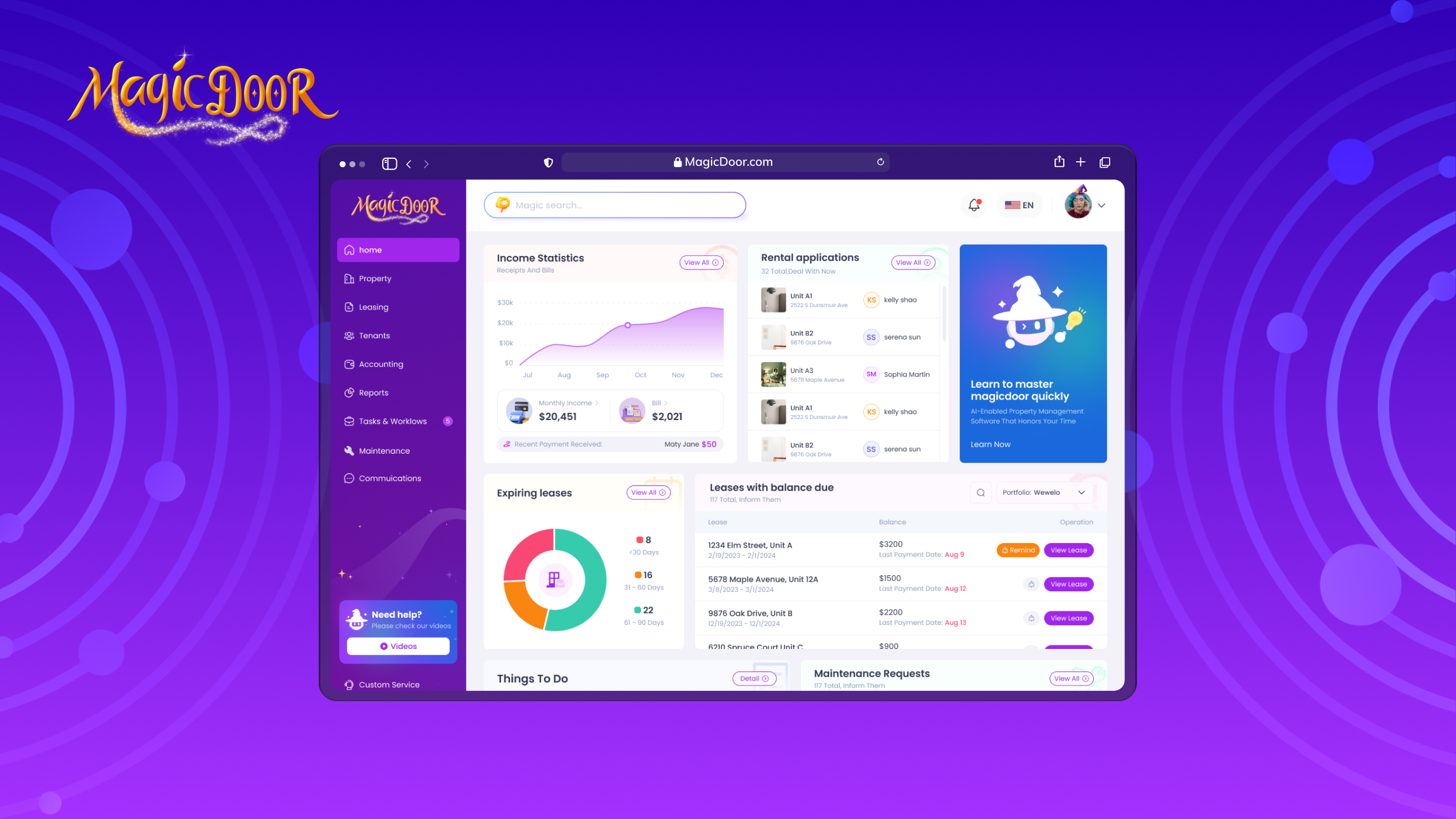
Why MagicDoor is the Best Option for Property Owners Looking for Owner Statement Software
Property managers evaluating owner statement software need reporting that is accurate, automated, and easy for owners to access.
MagicDoor closes reporting as part of the main property management, not as an afterthought layered on top.
Here’s where it delivers:
- Automated monthly owner statements: Generates structured reports automatically based on recorded rental income, income expenses, and calculated property management fees, reducing manual processing each month.
- Accurate net income calculation: Computes net income directly from live transaction data so property owners see real property performance, not adjusted summaries.
- Integrated financial tracking: Connects rent collection, maintenance costs, and fee deductions inside one system, so owner statements reflect actual financial activity without external exports.
- Secure online portal access: Gives property owners 24/7 access to statements and financial reports through an online portal, improving transparency and reducing back-and-forth communication.
- Clear income & expense breakdown: Organizes income expenses into structured categories so reports are readable and focused on what owners care about most.
- Scalable reporting for growing portfolios: Maintains consistent reporting standards as property managers increase unit count, supporting long-term growth.
For property managers, the benefit is functional stability. For property owners, the benefit is clarity. When reporting is accurate, accessible, and consistent, trust becomes the default rather than something you constantly need to repair.
Conclusion
Choosing owner statement software is about more than generating monthly reports.
It determines how clearly property owners see rental income, income expenses, and net income, and how confidently they evaluate property performance.
The right system supports automation, accurate financial tracking, trust accounting compliance, scalable reporting, and transparent online portal access. The wrong one adds friction, risk, and unnecessary manual work.
If you’re ready to simplify reporting and provide structured, accurate owner statements without extra effort, it’s time to look at MagicDoor. Explore how MagicDoor can support your property management workflow and bring consistency to your owner reporting process.
Get started today!