
Best Bookkeeping Software for Property Managers & Landlords
Get expert property management insights, straight to your inbox.
Managing rental property finances isn’t complicated because it’s hard, it’s complicated because it’s layered.
You’re dealing with rent collection, maintenance tracking, bank reconciliations, owner reports, and still trying to remember if that $312 expense was for Unit 3B’s water heater or just bad bookkeeping.
That’s why finding the right bookkeeping software for property managers and landlords matters. The good ones handle the math, the mess, and the month-end panic, all while staying tailored to how you run your rentals.
In this guide, you’ll compare the top tools for 2026, ranked by accounting features, ease of use, and those that make income and expense tracking feel less like a chore and more like a business asset. From small landlords to pros managing large portfolios, there’s a smart option that fits your style and finally gives you numbers that make sense.
What to Look for in Bookkeeping Software for Property Management
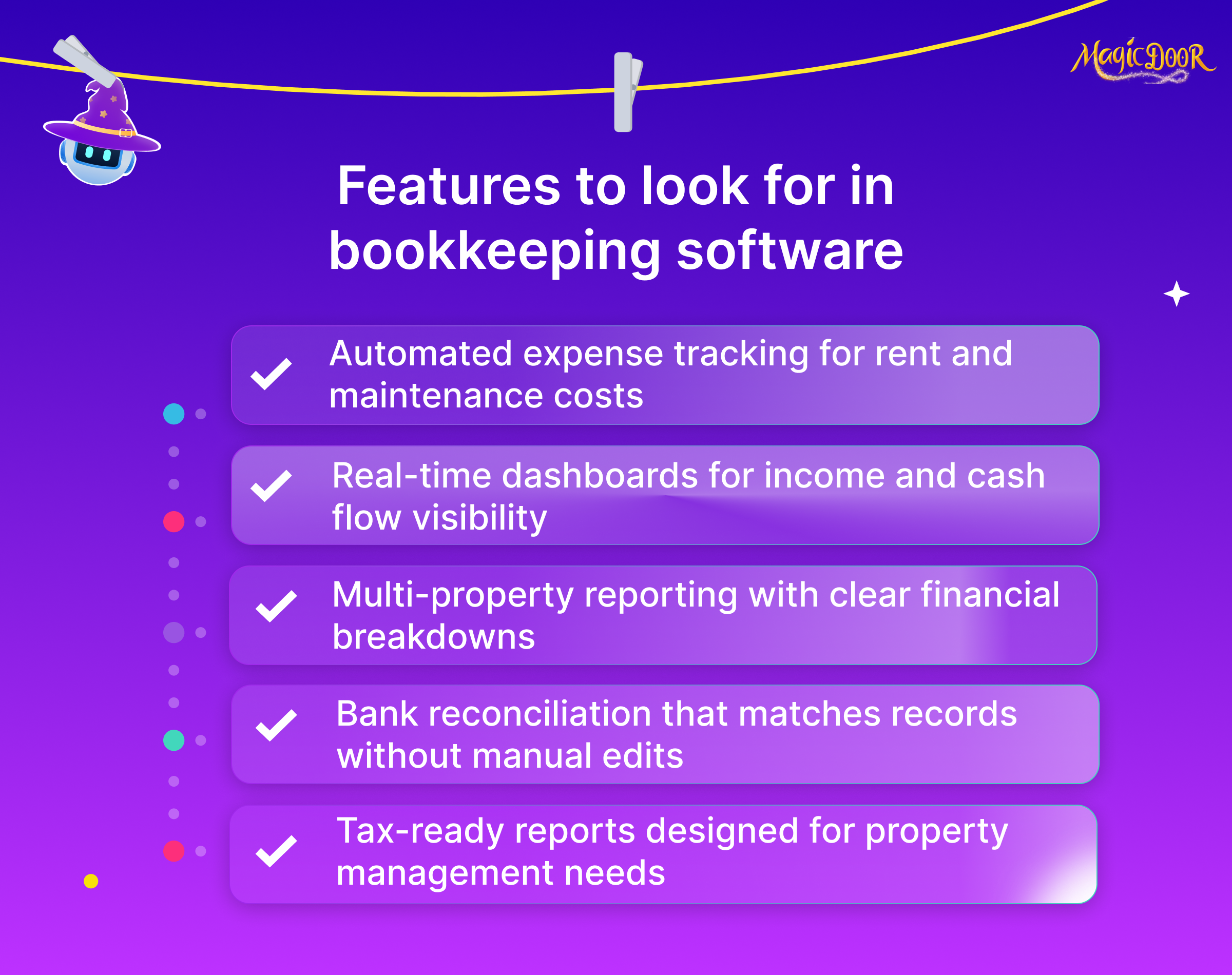
Managing property finances gets complicated fast, particularly when you’re dealing with multiple properties, late fees, maintenance costs, and online rent collection.
That’s where specialized bookkeeping software for property managers makes a real difference. The best tools aren’t just spreadsheets with a login. They combine accounting features, reporting, and property management tools that help you save time and stay compliant, without needing a CPA on speed dial.
So, what should you be looking for?
- Tracks rental income and expenses by property or unit
- Automates recurring rent payments and late fees
- Generates owner statements, Schedule E exports, and custom financial reports
- Supports 1099s and year-end tax preparation
- Includes bank reconciliation tools to match your transactions
- Offers trust accounting for property owner funds
- Integrates with property management software or leasing tools
- Scales easily for small landlords or large portfolios
- Simple, user-friendly design with mobile access for on-the-go updates
If you're still using spreadsheets to track income, manage expenses, and prep for tax time, you’re probably spending hours each month doing work your software could handle in minutes.
Whether you're a hands-on landlord managing a few units or a growing team overseeing hundreds of doors, the right bookkeeping system should do more than just record transactions. It should help you:
- Collect rent online with automated reminders
- Stay audit-ready with clean financial records
- Get real-time insights into property performance and cash flow
- Support your full rental property lifecycle, from tenant screening and lease agreements to bank account syncing and debit card tracking
And let’s be honest, bookkeeping is rarely the part anyone looks forward to. But the right tools can make it almost painless. (Almost 😉)
Top 11 Accounting Software for Property Managers & Landlords in 2026
1. MagicDoor
MagicDoor is an all-in-one property management software for modern landlords and property managers.
Alongside tools for rent collection, tenant screening, and maintenance tracking, MagicDoor includes powerful accounting features designed to make rental property bookkeeping fast, accurate, and easy to manage.
Key bookkeeping features:
- Track rental income and expenses by unit
- Automate rent payments and reminders
- Generate owner statements and income and expense reports
- Support for 1099 tax reporting
- Built-in bank reconciliation
- Chart of accounts tailored for property management
- Export-ready for QuickBooks integration
Pros: Purpose-built for property accounting, user-friendly, integrated platform
Cons: Custom setup may be more than needed for very small portfolios, but it still works well for them
Best for: Property managers and landlords managing multiple properties
Pricing: $2,50 per month per user. Accounting is included in the plan.
2. Stessa
Stessa is a free accounting software tool for real estate investors and landlords who want automated income and expense tracking across their rental properties. It connects to your bank account and categorizes transactions in real time.
Key bookkeeping features:
- Auto-categorizes expenses
- Tracks cash flow and property performance
- Generates financial reports and tax-ready exports
Pros: Free to use, easy setup, visual dashboard
Cons: Not designed for full-service property management
Best for: DIY investors managing a few rentals
3. Buildium
Buildium is a robust property management software with strong accounting tools for professional property managers. It supports full financial management for multiple properties and integrates directly with tenant operations.
Key bookkeeping features:
- Full trust accounting
- Accounts payable and receivable
- 1099 tax reporting and bank reconciliation
Pros: Built for managers, deep accounting functionality
Cons: May be more complex than needed for small landlords
Best for: Mid- to large-sized property management companies
4. AppFolio
AppFolio offers a powerful suite of property management tools, including comprehensive accounting features for tracking income and expenses, rent collection, and financial reporting at scale.
Key bookkeeping features:
- Double-entry accounting
- Automated rent payments
- Custom financial reports and owner statements
Pros: Great for growing portfolios, all-in-one platform
Cons: Pricing may not fit smaller portfolios
Best for: Teams managing multiple rental properties
5. Rentec Direct
Rentec Direct provides rental property management software with a strong focus on accounting for landlords and property managers. It balances automation and manual controls well.
Key bookkeeping features:
- Tracks income and expenses per property
- Includes bank reconciliation and chart of accounts
- Offers 1099 reporting tools
Pros: User-friendly, cost-effective for small portfolios
Cons: Interface feels dated compared to modern tools
Best for: Independent landlords and small firms
6. TenantCloud
TenantCloud combines property management and accounting tools in one platform, with a user-friendly experience aimed at DIY landlords and smaller investors.
Key bookkeeping features:
- Track rental income and expenses
- Create financial reports
- Accept online rent payments
Pros: Affordable, good for beginners
Cons: Limited automation for complex portfolios
Best for: Small landlords and part-time investors
7. QuickBooks (with Real Estate Add-ons)
QuickBooks can be adapted for rental property bookkeeping when used with real estate-specific add-ons. It works best when integrated with apps that support property management features.
Key bookkeeping features:
- General accounting tools
- Customizable chart of accounts
- Mileage and expense categorization
Pros: Widely used, flexible setup
Cons: Requires setup and integration for real estate use
Best for: Owners already using QuickBooks for other businesses
8. TurboTenant
TurboTenant is known for tenant screening and marketing, but it also includes basic bookkeeping features for landlords managing a few properties.
Key bookkeeping features:
- Tracks income and expenses
- Offers downloadable reports
- Supports rent collection
Pros: Free plan available, very easy to use
Cons: Limited accounting depth
Best for: DIY landlords who want simple financial tracking
9. Hemlane
Hemlane combines property management automation with specific financial tracking. It’s built for remote landlords managing properties from a distance.
Key bookkeeping features:
- Log transactions and rent payments
- Generate monthly financial reports
- Track maintenance expenses
Pros: Great for hands-off owners
Cons: No full-service accounting or trust accounting
Best for: Long-distance and hands-off landlords
10. Avail
Avail offers landlord-focused management tools, including basic bookkeeping for income and expense tracking. It’s easy to use and works well for those just getting started.
Key bookkeeping features:
- Exportable income and expense reports
- Simple rent tracking
- Syncs rent payments with reports
Pros: Clean UI, easy for beginners
Cons: Limited features for accounting accuracy
Best for: Small landlords managing fewer than five units
11. Wave
Wave is a free accounting software used by many small businesses, including real estate investors and landlords. While not designed for rentals, it can be customized for basic use.
Key bookkeeping features:
- Tracks income and expenses
- Offers bank reconciliation
- Includes cash flow tracking and invoicing
Pros: Free and simple for general use
Cons: No rental-specific features
Best for: Owners who want basic, low-cost accounting
How to Choose the Right Rental Property Bookkeeping Tool
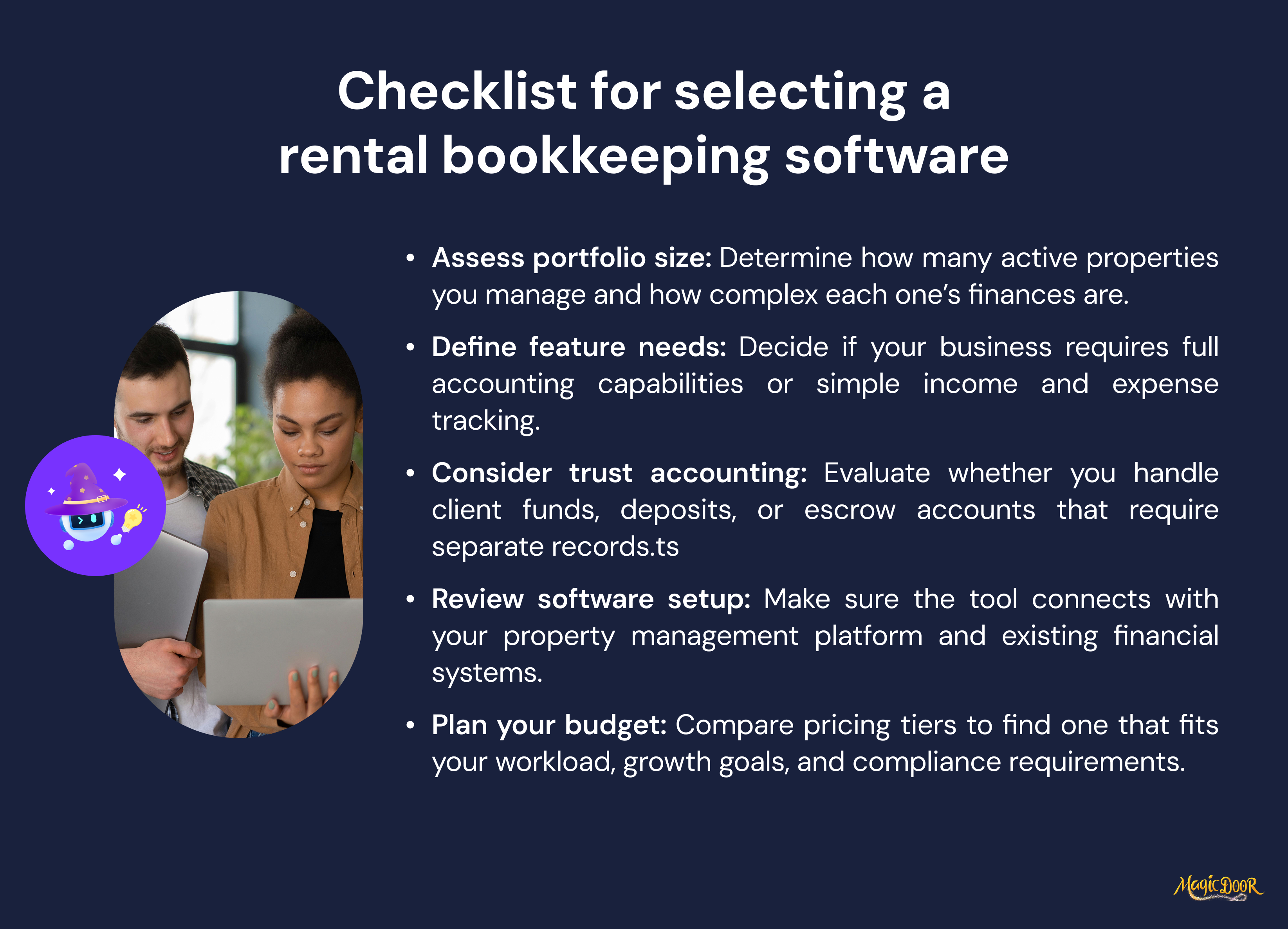
How Many Properties Are You Managing?
The number of units you manage will directly impact what kind of bookkeeping software you need.
- Independent landlords with just a few units may only need a lightweight tool for tracking rental income and expenses, automating rent payments, and handling basic tax preparation.
- But if you’re managing multiple rental properties or growing a larger rental portfolio, look for software with robust financial tracking, a chart of accounts for property management, and built-in tools for bank reconciliation and owner statements.
Some platforms are designed for landlords managing just a handful of properties. Others support complex portfolios with dozens, or even hundreds, of units across different ownership structures.
If your portfolio is growing, you’ll want a system that can grow with you, offering customizable features, property portfolio tracking, and support for things like depreciation tracking, accounts payable, and financial reports across properties.
The more doors you manage, the more you’ll appreciate built-in automation tools that reduce the time you spend on manual data entry and monthly reporting.
Do You Need Full Accounting or Just Basic Bookkeeping?
Before you choose a tool, ask yourself: are you just trying to stay organized, or do you want to fully automate your financial management?
Basic bookkeeping tools will handle things like:
- Income and expense tracking
- Exportable income and expense reports
- Manual entry of transactions
- Simple bank account connections
This works well if your property finances are straightforward, and you're comfortable handling tax time on your own or with a spreadsheet.
Full accounting software, on the other hand, includes features like:
- Double-entry accounting
- Chart of accounts tailored to property management
- Trust accounting (if you manage third-party funds)
- 1099 tax reporting, depreciation tracking, and QuickBooks integration
- Accounts receivable and payable
- Tools to track cash flow, automate rent collection, and manage late payments
If you’re running a growing real estate business or managing properties for others, full-featured accounting tools are more than helpful, they’re necessary.
And if you're not sure yet?
Start with a platform that offers both. Several tools let you upgrade as your needs grow, without losing your data.
Do You Need Trust Accounting?
If you manage funds on behalf of others, like owner payments, security deposits, or maintenance reserves, trust accounting isn’t optional.
You’ll need bookkeeping software that keeps these funds separate, tracks every transaction, and supports clean bank reconciliation. It should also help you avoid compliance mistakes by logging income, disbursements, and reconciliations in real time.
Even for small landlords, trust accounting becomes essential once you handle multiple properties or manage money that isn’t your own. A proper chart of accounts for property management makes this process easier and keeps your records clean during audits or tax preparation.
Look for tools that support audit trails, clear owner statements, and separation of operational vs. client funds, especially if you're scaling or working with multiple property owners.
Are You Already Using Property Management Software?
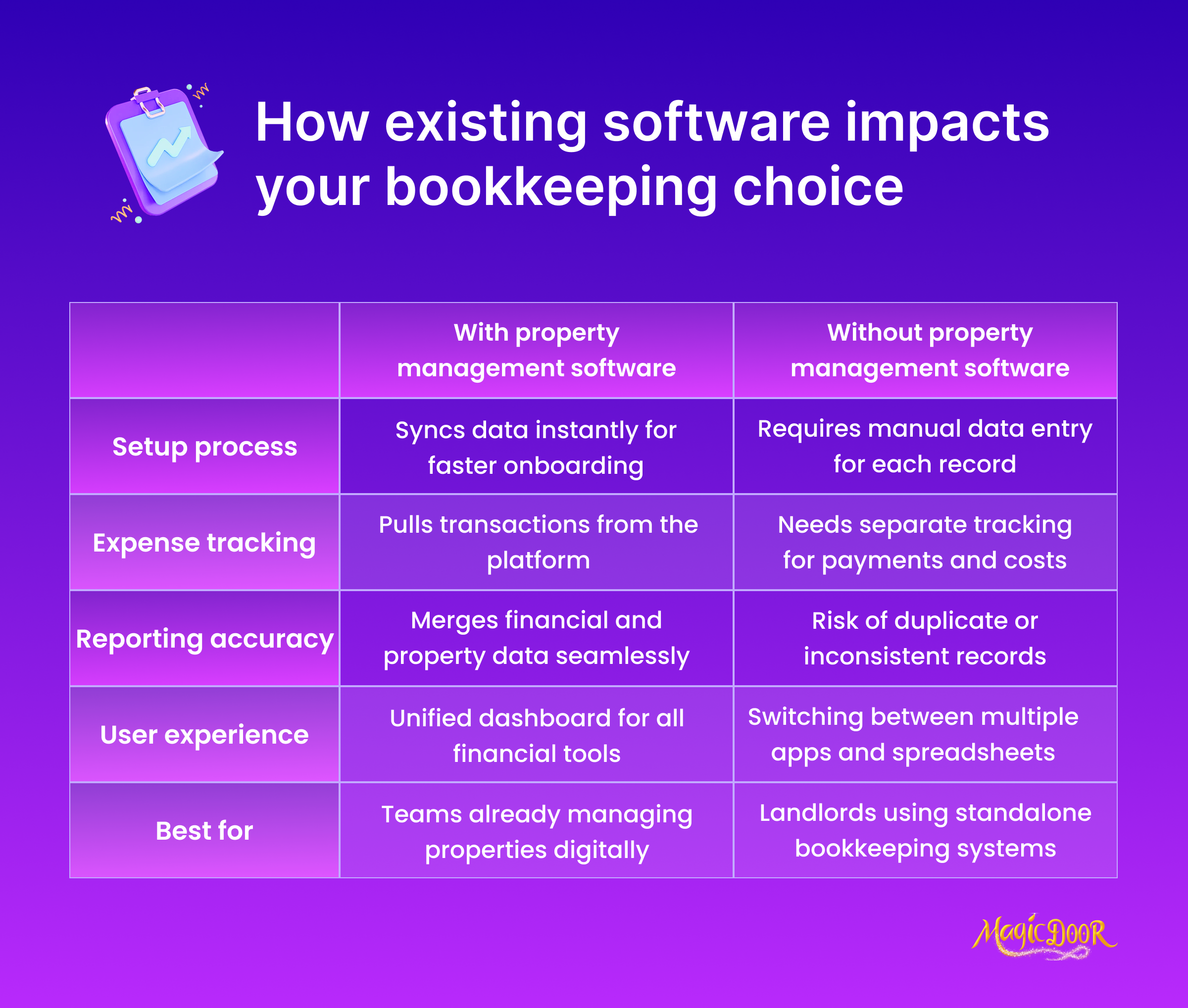
If you're already using property management software, your bookkeeping tool should either integrate smoothly, or be built to handle both sides of the business.
Handling rent collection, maintenance tracking, and tenant screening in one system, while tracking income and expenses in another, often leads to errors, missed entries, and duplicated work. Connecting your financial tracking with your management tools saves time, improves accuracy, and gives you a real-time view of your entire rental property operation.
It also helps ensure your accounting features line up with what you're doing day to day, from automated rent reminders and late fees, to tracking lease deposits and reconciling your bank account.
If your current software doesn’t offer reliable accounting tools or if the experience is clunky and time-consuming, it might be worth finding a solution that keeps everything under one roof.
What’s Your Budget?
Pricing for rental property bookkeeping software can range from free to hundreds per month, depending on features, portfolio size, and integrations.
Here’s what to consider:
- Are you a DIY landlord managing 1–3 units, or part of a team overseeing a large investment portfolio?
- Do you need full financial management, or just a way to track rental income and expenses?
- Are you okay with manual exports, or do you want automated payments, owner statements, and 1099 tax reporting included?
Low-cost tools may limit features like QuickBooks integration, depreciation tracking, or accounts payable and receivable. Higher-priced platforms often include full property management automation, which saves time across accounting, leasing, and operations.
Start with what you really need. Many landlords and property managers overspend on tools they don’t use, or underinvest in tools that could help them grow.
Managing Rental Finances is Easier with MagicDoor’s All-in-One Platform
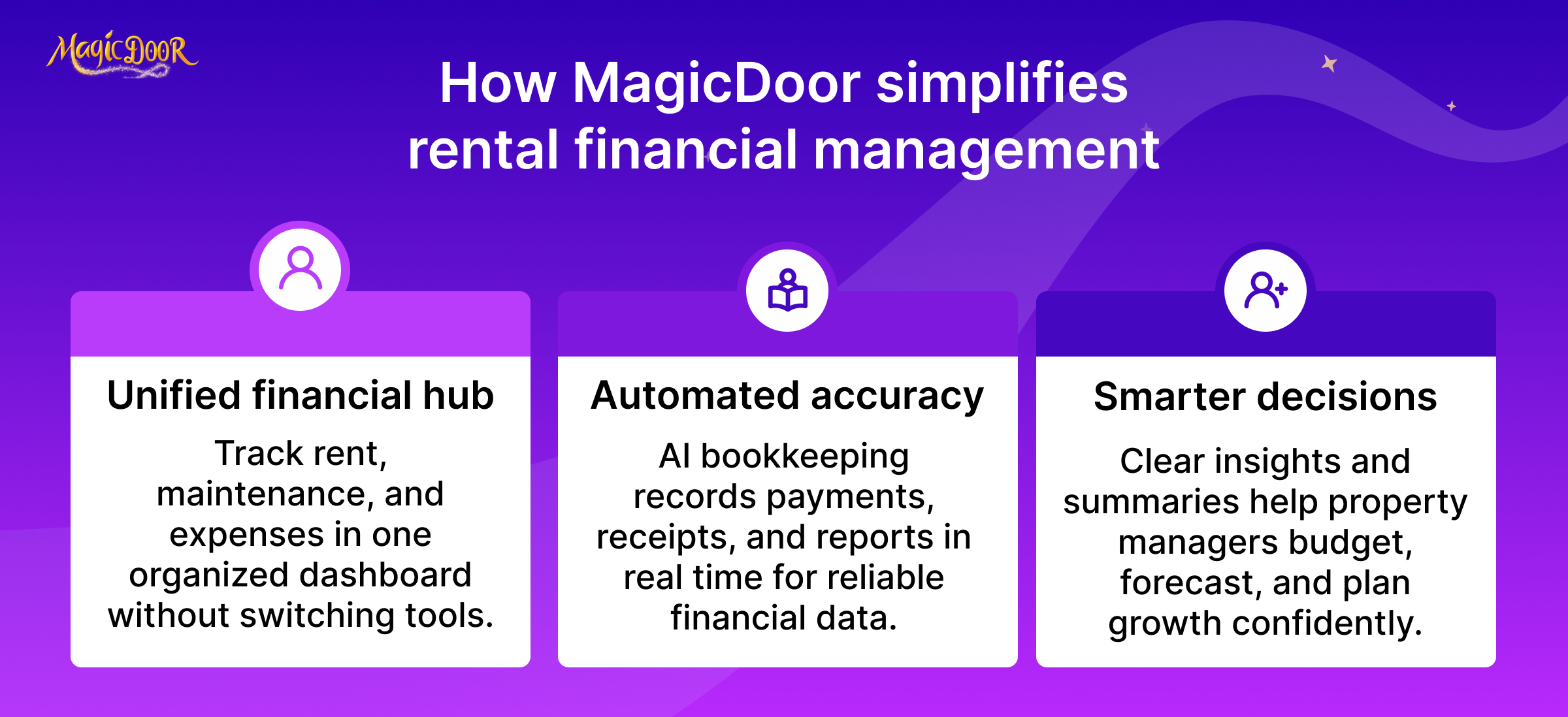
Keeping rental finances tidy takes time: rent payments, expense tracking, owner statements, and tax prep add up fast.
MagicDoor combines bookkeeping and property management features in one place so property managers and landlords get accurate financial tracking without switching tools.
What MagicDoor's accounting hub helps you do:
- Track rental income and expenses by property or unit
- Automate rent payments and automated rent reminders for tenants who collect rent online
- Generate owner statements, income and expense reports, and Schedule E exports
- Support 1099 tax reporting and other tax‑time exports
- Provide a tailored chart of accounts for property management and trust accounting when needed
- Reconcile with your bank account using built-in bank reconciliation tools
- Offer QuickBooks integration and export options for accountants
- Manage property portfolio tracking, accounts payable and receivable, and cash flow tracking
- Track depreciation, mileage, and categorize expenses for cleaner records
The platform also includes features that help with tenant lifecycle tasks, like maintenance tracking and tenant screening, so financial records reflect real activity. The interface is user-friendly and mobile accessible, giving real‑time insight into property performance and cash flow.
Think of MagicDoor as a finance dashboard that keeps your books current and saves time (and a few headaches) 😉
Conclusion
Trying to keep up with spreadsheets, receipts, late rent, and tax deadlines can turn any calm landlord into a coffee-fueled accountant. ☕
But with the right bookkeeping tool, all of that becomes a lot more manageable and a lot less time-consuming.
Excellent accounting software should do more than just balance numbers.
It should help you track rental income and expenses, stay ready for 1099s, monitor cash flow, and get real insight into how your rental properties are performing without needing a finance degree.
If you’re ready to stop guessing where your money’s going and start managing your rentals like a pro, you’re in the right place.
Get started with MagicDoor today. Just don’t wait until tax season to make the switch. 😉