
Best Lease Management Software For Property Managers
Get expert property management insights, straight to your inbox.
Lease management sits at the center of every rental operation.
It’s where property managers track rent schedules, renewals, and tenant obligations, yet it’s also where most delays and disputes begin. When leases live in folders, inboxes, or shared drives, small errors turn into missed payments or legal headaches.
Manual workflows slow teams down and increase the risk of property inconsistencies. Manually managing each lease, amendment, and renewal usually results in duplicate data and outdated records, especially as the number of prospective tenants and active units grows.
The best lease management software eliminates that chaos.
It centralizes everything: agreements, payments, and communication with tenants. Property managers can pay rent online, review tenant data, and maintain compliance in one system.
This guide compares the leading tools for 2026, highlighting their core features, pricing structure, and which type of landlord or portfolio each one suits best.
What is Lease Management Software?
Lease management software is a digital system designed to handle the full lease lifecycle, from creating agreements to renewals, rent collection, and compliance tracking. It centralizes documents, payments, and tenant communication so nothing gets missed.
Here’s what landlords and managers can expect:
- Secure storage for lease agreements and supporting documents
- Online rent collection with detailed payment histories
- Automated reminders for renewals, rent reviews, and compliance deadlines
- Built-in reporting that connects lease data to financial performance
For property owners, this means more accuracy. For managers, it means less manual work and faster decisions.
Top 12 Lease Management Software For Landlords & Property Managers
1. MagicDoor
MagicDoor has become a go-to option for landlords and property managers who want real lease automation without the learning curve of enterprise tools. It connects every step of the leasing process, from tenant screening to renewals, into one workflow that runs quietly in the background.
Applications, credit checks, and lease agreements move through the system in minutes, not days, giving property teams a clear picture of what’s signed, paid, and due next.
MagicDoor's lease management features:
- AI-based application scoring for faster approvals
- Instant background and credit checks
- Digital lease signing via text or link
- Renewal and move-out workflows with automated alerts
- Local law templates to reduce compliance risk
- Exportable lease and payment data for full transparency
Best for: Landlords and property managers who want user-friendly software that keeps the lease lifecycle visible from application to renewal, ideal for teams ready to move beyond manual spreadsheets without losing control of their portfolio.
2. Buildium
Buildium is one of the longest-standing names in lease management software.
It is trusted by property managers who oversee larger real estate portfolios. It offers a structured way to manage lease agreements, renewals, and rent collection, along with accounting and reporting.
Buildium's lease management features:
- Online lease creation and digital signing
- Automated rent reminders and payment tracking
- Centralized lease lifecycle management dashboard
- Renewal alerts and compliance tracking
Best for: Mid-sized and large property management teams that need advanced accounting tools and reliable lease administration under one platform.
3. AppFolio
AppFolio blends property management and leasing tools with built-in automation that appeals to data-driven managers. Its interface supports lease administration, rent collection, and tenant screening in one user-friendly system that scales easily.
AppFolio's lease management features:
- Digital lease workflows with renewal tracking
- Integrated tenant screening and online rent payment
- Lease templates aligned with regional regulations
- In-platform communication with prospective tenants
Best for: Property managers seeking an all-in-one property management software with strong reporting and automation for larger residential or mixed-use portfolios.
4. Landlord Studio
Landlord Studio caters to independent landlords looking for a lighter lease management solution without sacrificing essential features. It simplifies the leasing process and tracks financial performance with clear, user-friendly tools.
Landlord Studio's lease management features:
- Digital lease storage and renewal tracking
- Income and expense monitoring linked to each lease
- Online rent payment and late fee automation
- Custom reports for financial performance insights
Best for: Individual landlords or small property teams who prefer straightforward lease management software that balances automation with control.
5. TenantCloud
TenantCloud is flexible lease management software that helps property managers manage applications, lease agreements, and rent collection in one platform. It’s known for being user-friendly, especially for smaller portfolios that still need organized digital workflows.
TenantCloud's lease management features:
- Customizable digital lease templates and renewals
- Online rent payment and automatic reminders
- Built-in tenant screening and applicant tracking
- Secure document storage for all lease agreements
Best for: Landlords managing a handful of rental units who want affordable, easy-to-learn property management software that reduces human error and improves communication with potential tenants.
6. Re-Leased
Re-Leased was built for commercial real estate teams that need detailed control over the leasing process. It focuses on structured lease renewals, financial tracking, and automated workflows that simplify property administration at scale.
Re-Leased's lease management features:
- Lease lifecycle tracking with custom alerts
- Integrated rent schedules and payment logs
- Portfolio performance insights with accounting integration
- Role-based access for property managers and accountants
Best for: Commercial property managers or mixed-use portfolio owners who need advanced oversight of complex lease agreements and recurring rent schedules.
7. Rentec Direct
Rentec Direct offers a full suite of property management tools designed to help property managers stay organized and compliant. Its lease management features support digital storage, renewals, and tenant screening under one dashboard.
Rentec Direct's lease management features:
- Centralized lease documentation and renewal tracking
- Integrated tenant screening and background checks
- Online rent collection and late fee automation
- Custom reminders to reduce human error in lease terms
Best for: Property managers seeking reliable, affordable management software that streamlines lease tracking and tenant screening for small to mid-sized residential portfolios.
8. MRI Software
MRI Software is known for its enterprise-grade lease management tools, which are used across large real estate portfolios. These tools combine robust reporting, automation, and compliance support to give property managers full visibility into lease renewals and tenant activity.
MRI Software's lease management features:
- Centralized database for commercial and residential leases
- Automated rent schedules and payment tracking
- Configurable workflows for lease renewals and amendments
- Compliance management and document version control
Best for: Enterprise property management teams that need a powerful platform for tracking complex lease structures and financial reporting across multiple portfolios.
9. Entrata
Entrata delivers a full property management software suite with lease management at its core. It helps property managers oversee applications, payments, and tenant communication from one dashboard. The platform’s design focuses on keeping leasing tasks efficient and transparent.
Entrata's lease management features:
- Unified leasing process with digital applications and renewals
- Online payment options and automated reminders
- Built-in tenant screening tools and data tracking
- Performance insights for each property
Best for: Property managers seeking an integrated leasing and accounting system that supports large residential communities and student housing operations.
10. Propertyware
Propertyware is a flexible lease management software tailored to single-family property managers and franchise groups. It connects the leasing process with accounting, maintenance tracking, and communication tools, helping reduce manual work and data duplication.
Propertyware's lease management features:
- Online lease creation and digital signing
- Automated renewal alerts and rent increases
- Customizable lease templates for regional requirements
- Real-time payment and tenant activity tracking
Best for: Property managers overseeing scattered-site rentals who need user-friendly management software that combines leasing, rent tracking, and maintenance coordination in one place.
11. FinQuery
FinQuery (formerly LeaseQuery) specializes in lease management and accounting automation, making it a strong fit for property managers who handle complex reporting or audit requirements. Its focus on accuracy and compliance helps teams track every lease term with confidence.
FinQuery's lease management features:
- Centralized tracking of lease terms and amendments
- Built-in alerts for key dates and renewals
- Automated accounting and reporting functions
- Role-based access for larger property teams
Best for: Real estate firms and corporate property managers that prioritize compliance, detailed reporting, and financial accuracy in their lease management software.
12. Rent Manager
Rent Manager is a flexible, modular platform that integrates property management and lease administration. It supports everything from digital lease creation to payment processing, helping property managers organize every stage of the leasing process.
Rent Manager's lease management features:
- Online lease management and renewal workflows
- Integrated tenant screening and payment options
- Custom lease templates for different property types
- Cloud-based access for real-time collaboration
Best for: Property managers who want comprehensive property management software that combines leasing, accounting, and tenant communication tools in a single, scalable system.
Lease Lifecycle Overview
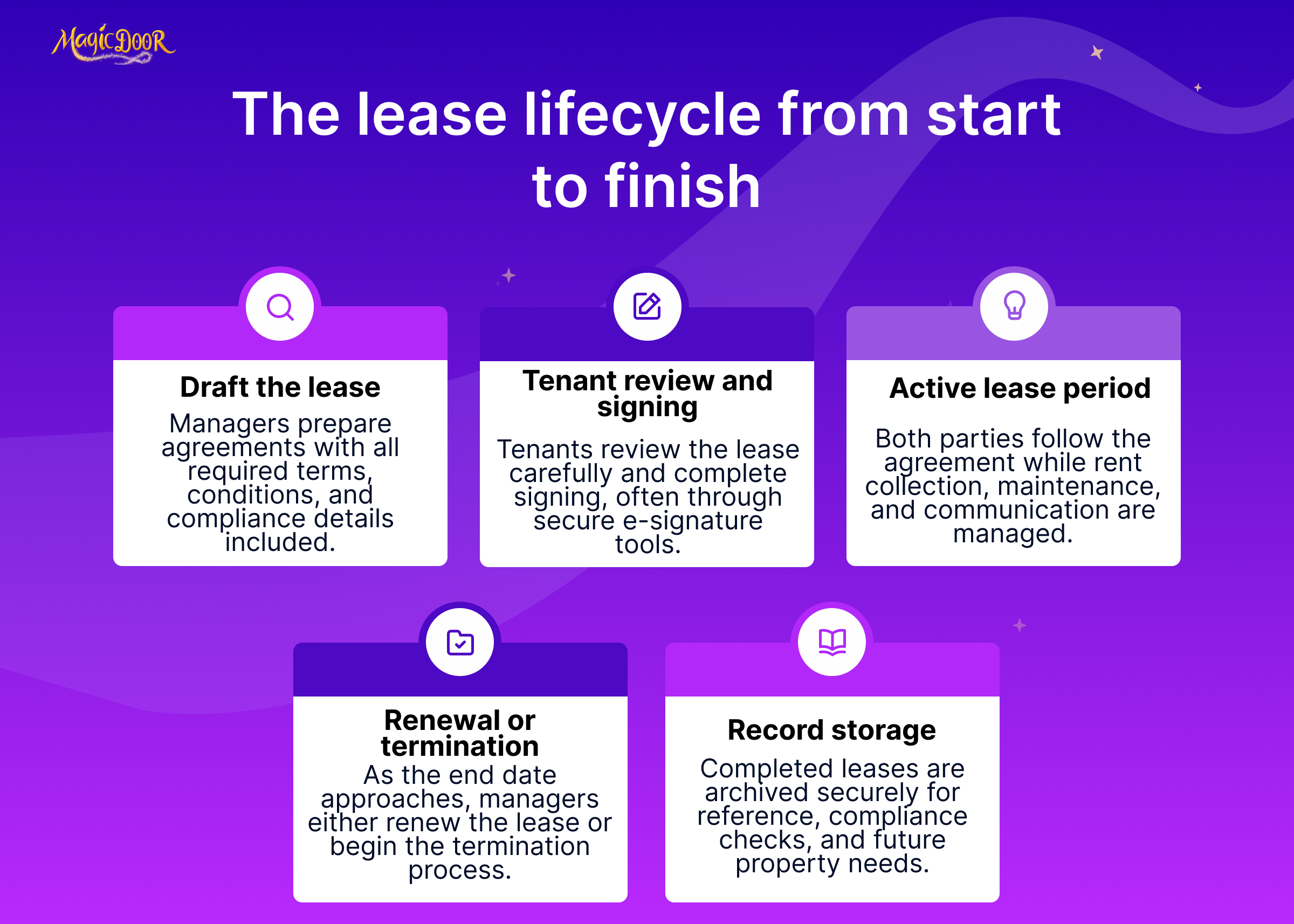
A lease doesn’t begin and end with a signature. It’s a full cycle of responsibilities that touches every part of property management. Landlords and property managers who oversee multiple rental properties need clear steps to keep agreements accurate, payments flowing, and compliance in check.
The lifecycle usually unfolds in four stages:
- Creation & signing: preparing lease agreements, screening tenants, and securing digital signatures.
- Ongoing management: tracking rent collection, logging maintenance requests, and storing lease documents.
- Renewal or review: evaluating tenant history, deciding on rent reviews, and issuing renewal notices.
- Closing & reporting: finalizing deposits, documenting rental history, and generating financial reports.
Handled well, the lease lifecycle creates smoother tenant relationships, reduces costly mistakes, and improves financial clarity for property owners.
Features to Look For in Lease Management Software
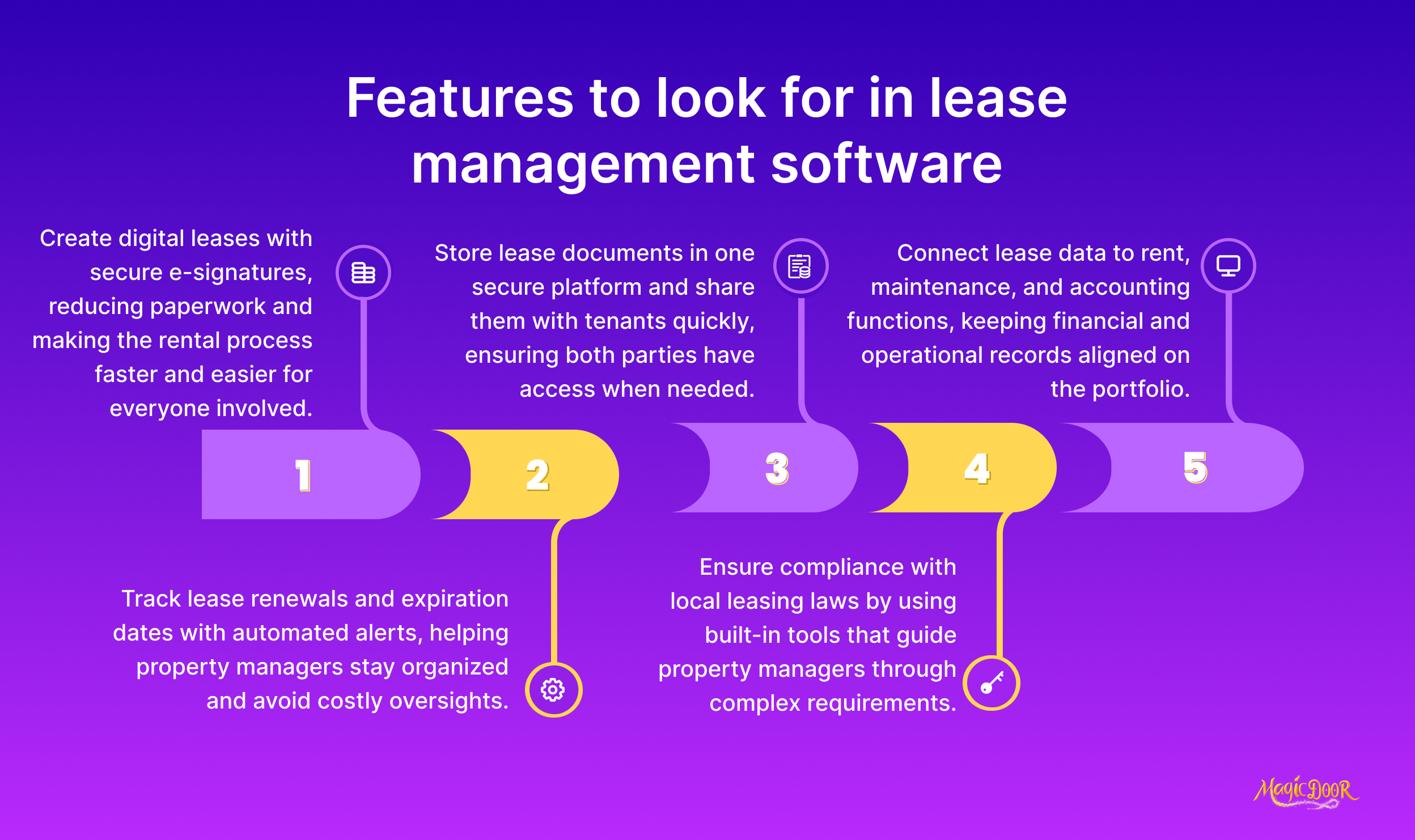
Create Digital Leases With E-Signatures
Paper agreements slow down the leasing process.
With digital lease management software, property managers can draft contracts, share them instantly with prospective tenants, and capture legally binding e-signatures in minutes. This eliminates delays from mailing or in-person meetings and provides a secure digital trail of every lease agreement.
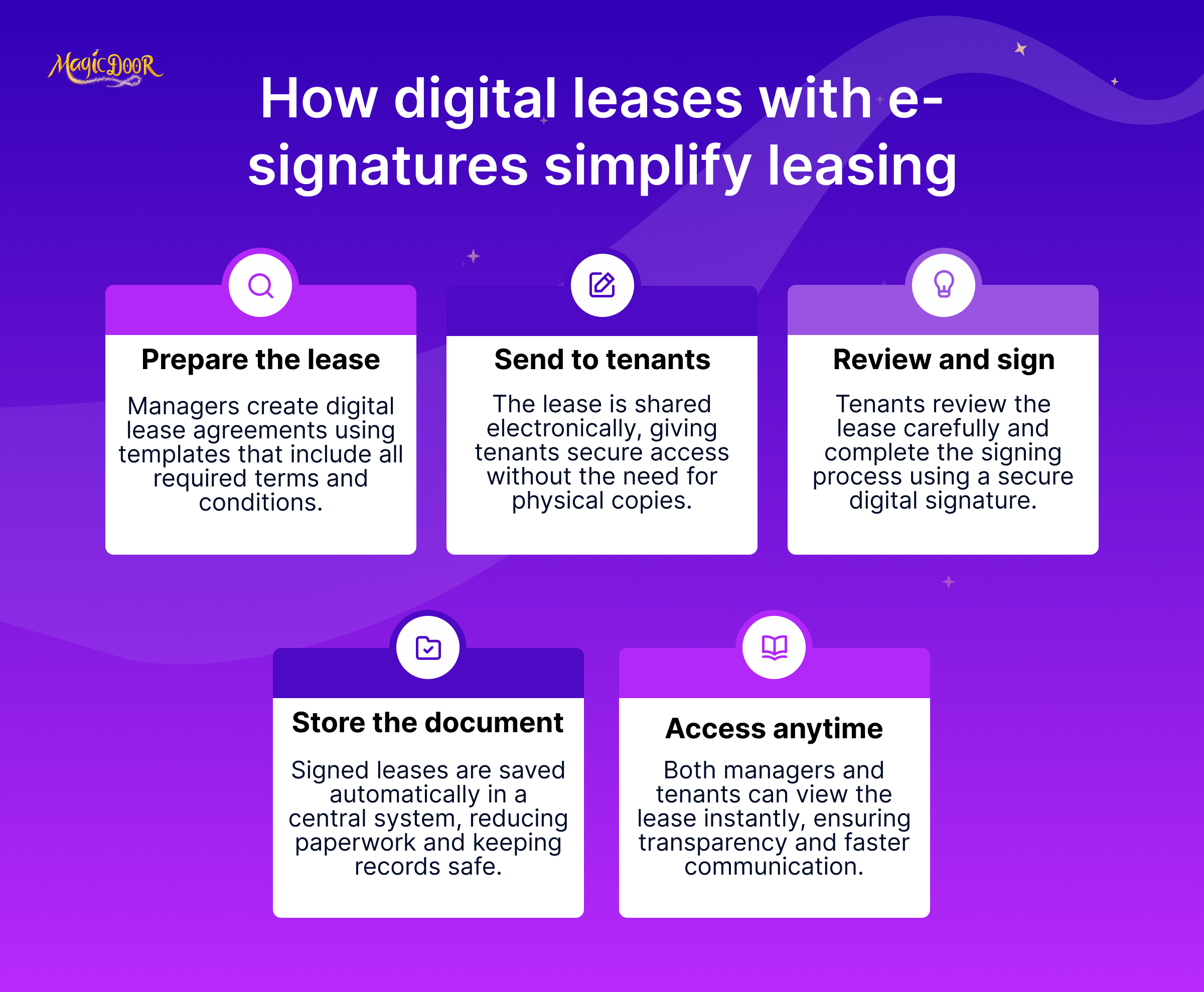
Benefits of e-signatures in lease management software:
- Faster leasing cycle and reduced vacancy time
- Easy storage of signed lease documents on one platform
- Real-time access for both tenants and property owners
Track Lease Renewals & Expiration Dates
Missed renewals can result in costly tenant turnover or unexpected vacancies.
Lease management tools keep expiration dates front and center, sending automated reminders to property managers and tenants. This helps owners plan rent reviews, initiate renewal conversations early, and avoid compliance gaps.
What effective renewal tracking should offer:
- Automated alerts for upcoming lease expiration dates
- Centralized dashboard showing active, pending, and closed leases
- Integration with rent payments and financial reporting to evaluate tenant performance
Store Lease Documents & Share With Tenants
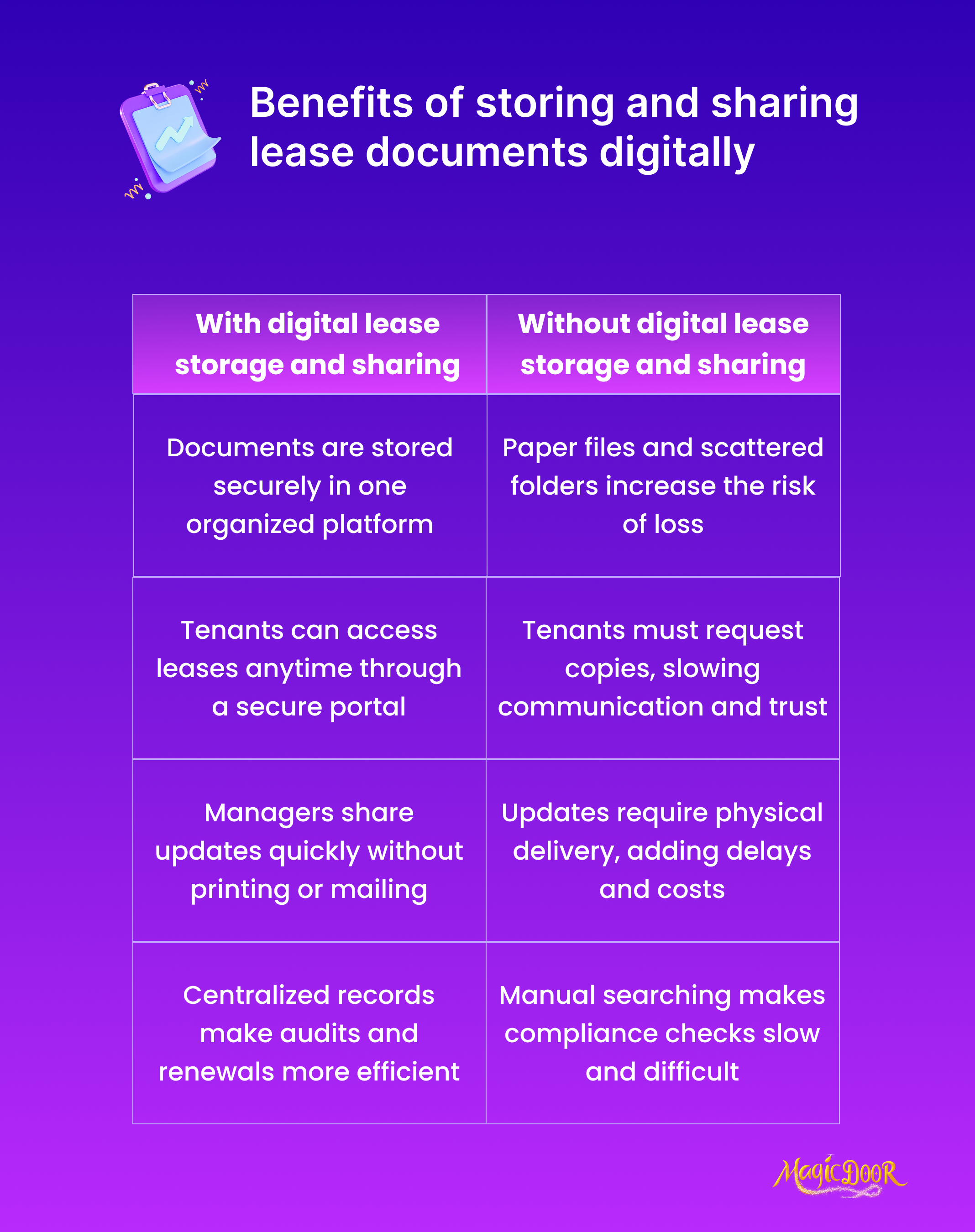
Lease administration depends on reliable records. When property managers rely on paper copies or loosely organized folders, small details, like renewal clauses or notice periods, get lost. A structured lease management system solves this by creating a verified, chronological archive for every document tied to a property.
Centralized storage connects the full leasing process: the initial lease draft, tenant signatures, rent adjustments, and renewal terms all live in one digital record. Having that information in a single platform prevents duplicate versions and reduces the back-and-forth that delays lease approvals.
Many platforms now include secure tenant access.
Sharing documents through a portal lets residents view signed agreements, receipts, and notices without direct email exchange. For property managers, it keeps communication documented and auditable, facilitating future reviews or disputes.
Key advantages of integrated document storage:
- One source of truth for every lease version
- Easier renewals and term updates
- Controlled visibility for tenants and staff
- Automatic linkage between lease files and rent history
Far from focusing on paperwork, teams can analyze trends, such as renewal rates or average lease duration, and make better decisions about portfolio performance.
Ensure Compliance With Local Leasing Laws
Regulation is one of the least visible but most demanding aspects of property management. Lease language, disclosure forms, and notice periods vary by city and are updated more often than most owners realize.
Lease management software helps maintain compliance by embedding regional templates and automated reminders. When a local ordinance changes, managers can adjust terms or generate updated documents without starting from zero. Some systems even cross-reference expiration dates with renewal rules to prevent accidental over- or under-extension of leases.
This structure replaces the manual process of checking spreadsheets or relying on memory. It also protects tenants and owners by aligning all contracts with current legal requirements.
Practical compliance features to look for:
- Built-in legal templates for regional standards
- Renewal and notice period alerts
- Version history for lease edits
- Secure record of executed agreements
Compliance isn’t only about avoiding fines; it’s about operational consistency. A transparent, traceable leasing process builds confidence among owners, tenants, and auditors.
Connect Lease Data to Rent, Maintenance, & Accounting
A lease record it’s a data point that drives financial and functional planning. When lease terms, rent payments, and maintenance costs live in separate systems, it isn’t easy to understand a property’s actual performance.
Integrated lease management brings those elements together.
Rent data syncs directly with accounting ledgers, giving managers a live view of cash flow and arrears. Maintenance requests link to unit records, so repair expenses appear in the correct cost center. Renewal information flows into forecasting tools, helping owners anticipate occupancy and revenue patterns.
By connecting these processes, property managers move from reactive problem-solving to proactive oversight. Instead of reconciling figures at month-end, they can see the financial impact of each lease in real time and act before issues escalate.
Essential integrations that strengthen lease visibility:
- Rent payment tracking tied to lease status
- Maintenance logs attached to each property record
- Accounting synchronization for income and expenses
- Forecasting tools linked to renewal schedules
The result it’s reliable information. When data moves seamlessly between functions, teams can focus on improving portfolio value instead of reconciling numbers.
How to Choose the Right Lease Software for Your Rental Properties
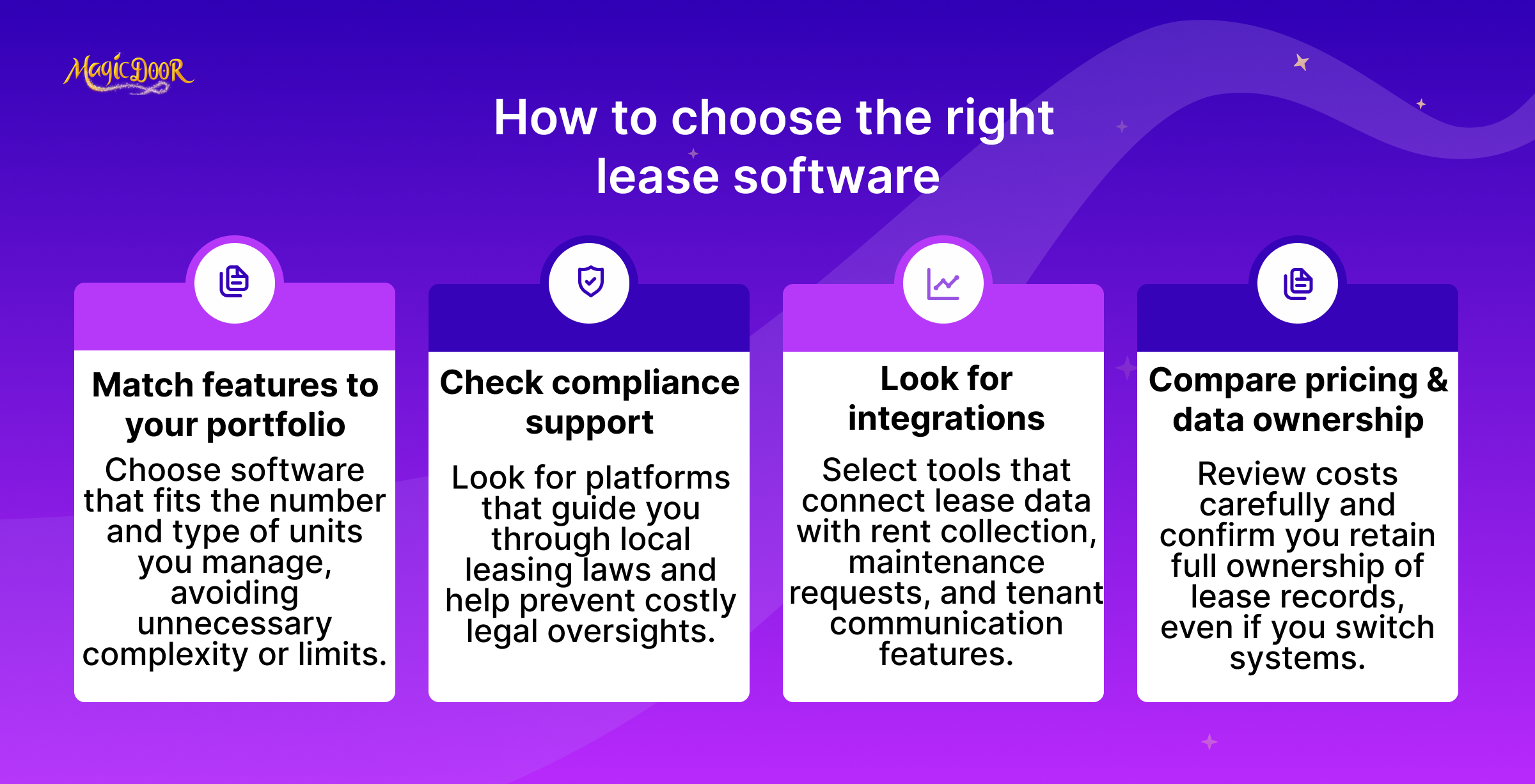
Match Lease Features to Your Portfolio Size
Every property portfolio has a different rhythm.
A landlord with five units doesn’t face the same operational load as a company managing hundreds of leases. The best lease management software adapts to that scale rather than forcing one workflow on everyone.
For small or mid-sized portfolios, simplicity and clarity matter most. Core features like digital lease creation, rent tracking, and tenant messaging keep daily work structured without adding unnecessary complexity.
Systems built for individual landlords often emphasize a user-friendly dashboard, easy lease renewals, and automated reminders that help save time on repetitive tasks.
Larger portfolios demand stronger administrative depth.
Advanced reporting, role permissions, and integrations with accounting or maintenance modules allow property managers to manage multiple teams while keeping lease data consistent. This balance between usability and control defines how scalable a platform truly is.
Evaluating how your team operates, who enters lease information, who reviews renewals, and who handles rent payments helps narrow the list quickly.
The right lease management software doesn’t overwhelm smaller operations or limit larger ones. It fits the portfolio’s structure from day one.
Check for Local Law & Compliance Support
Leasing rules usually change from city to city, and property managers feel that complexity most when scaling.
Each region can have its own notice requirements, disclosure formats, and deposit regulations. A reliable lease management platform anticipates these differences instead of leaving users to research them manually.
Modern lease administration tools include pre-built templates or clauses that align with regional standards. They flag missing information and send renewal alerts when compliance deadlines approach. That structure turns legal consistency into part of the leasing process rather than a side task handled through memory or spreadsheets.
Good compliance support also helps protect financial performance.
Automated checks reduce the chance of invalid lease terms, saving time otherwise spent fixing errors after signing. For property managers handling several markets, this layer of protection matters as much as rent tracking or maintenance coordination.
When evaluating lease management software, look for compliance tools listed among the key features, not as optional add-ons. They’re what keep a growing real estate portfolio organized, lawful, and trusted by both owners and tenants.
Look for Integration With Rent & Tenant Tools
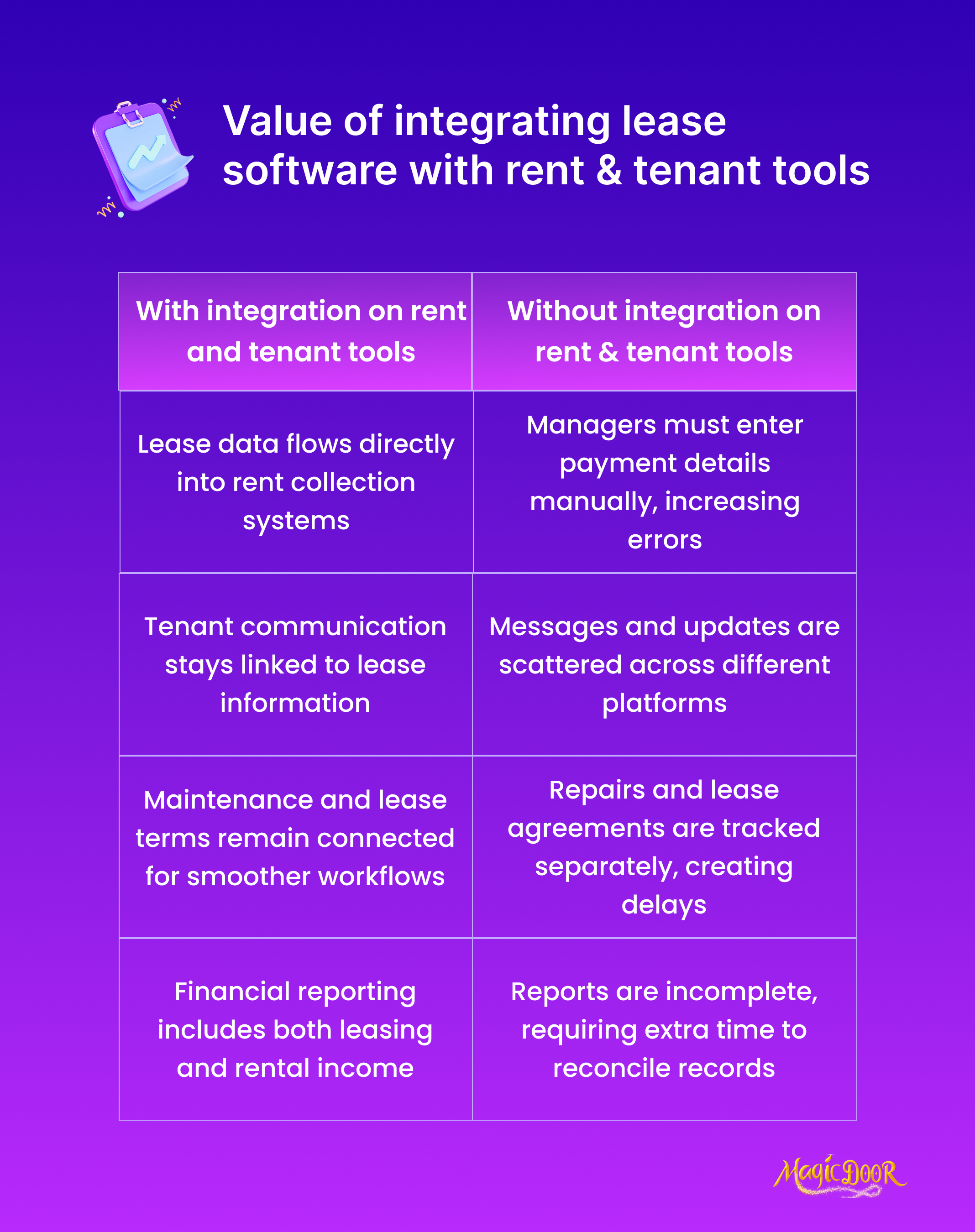
Picture a renewal day. You open the lease and, on the same screen, see the tenant’s payment streak, the last two service tickets, and the full message history.
There are no exports, no guessing, just the story of that lease in one place.
That’s the test for integration. Strong lease management software links lease records to rent payments, tenant screening results, maintenance activity, and communication logs.
Each update lands where it belongs: a rent payment posts to the ledger tied to that lease; a repair closes and is recorded under the unit and the tenant; a message thread stays attached to the agreement. The leasing process becomes traceable from screening to renewal, which reduces duplicate work and data import.
Use a quick checklist when you evaluate platforms:
- Rent activity is visible inside each lease record, not in a separate report
- Maintenance requests linked to the unit and the tenant, with timestamps and outcomes
- Screening results stored with rental history to support renewal decisions
- Role-based visibility so owners, property managers, and accountants see what they need
- Reliable exports for leases, payments, and messages for audits or migration
When these links are in place, portfolio reviews speed up, renewal choices improve, and human error drops because the information lives with the lease that created it.
Compare Pricing & Ownership of Lease Data
When you pick software, two contracts are at play: the subscription you sign and the control you exercise over your information.
Both shape the total cost and long-term flexibility.
Start with the pricing model. Some tools charge per unit, others per user, and many gate key features in higher tiers.
A plan can look light at ten units and feel heavy at fifty. Map the numbers to your portfolio growth, then check storage limits, backup policies, and whether critical features, lease renewals, payment exports, and API access sit behind a higher tier.
Then review who controls the data. You want lease agreements, payment history, tenant records, and messages fully exportable in standard formats. Look for clear terms on backups, retention, and migration help.
If you need to move platforms or run an external analysis, your portfolio should travel with you.
A focused comparison list helps:
- Export rights for leases, rental history, and reports (CSV/PDF/API)
- Predictable cost as properties are added, not surprise add-ons
- Included backups and documented recovery steps
- Security practices for sensitive lease information (encryption, access logs)
- Support response times and migration assistance spelled out in writing
Choose the tool that matches current needs yet keeps lease data portable. That balance protects financial performance now and keeps options open as the portfolio grows.
Why MagicDoor is a Smart Choice for Lease Management
Most lease management tools talk about “saving time” as if that alone solves everything. But time isn’t useful if you’re still hunting missing documents or manually tracking renewals.
MagicDoor fixes that problem in a quieter way by connecting every part of the leasing process so property managers can focus on their portfolio, not their paperwork.
Here’s what makes it work.
- One platform that handles the full leasing process: Applications, background checks, lease agreements, and rent payments live in one place. The system moves data automatically between each step, so the lease lifecycle flows without constant supervision.
- AI scoring that sorts applications before your next coffee: MagicDoor reviews rental applications on a 100-point scale, using credit and rental history data to help managers spot qualified tenants faster. It won’t decide who to approve, but it will spare you the 90 minutes of tab-switching that usually precedes that decision.
- Digital signing that tenants actually complete: No more “did you get the email?” moments. Tenants can sign lease agreements directly from their phones or through a simple link. Once signed, every lease sits in the same record, ready for future renewals or audits.
- Renewals and compliance handled quietly in the background: The platform monitors lease expiration dates, sends renewal alerts, and uses pre-built templates aligned with local laws. That means fewer legal surprises and fewer forgotten clauses hiding in old documents.
- Transparent pricing, $2.50 per user, full access included: Every account includes all the features. No hidden upgrades, no limited tiers, no “enterprise pricing” mystery. What you see is what you actually pay.
- Lease data you truly own: All lease files, payment records, and tenant notes can be exported anytime. The portfolio belongs to the manager, not the software. It’s a small detail that saves big headaches when expanding or switching systems.
- A roadmap that listens to property managers: Upcoming features, like showing coordination, will automatically match property availability with prospective tenants. It’s one more nudge toward the version of leasing everyone wants: faster, cleaner, and slightly less paperwork-heavy than last year.
MagicDoor doesn’t try to reinvent real estate. It simply makes the daily grind of leasing feel structured, predictable, and, on a good day, even satisfying.
Conclusion
Digital lease management isn’t a luxury anymore, it’s the basis of organized property management.
When leases move through automated systems, teams avoid errors, missed renewals, and backlogged communication. The difference shows up quickly: fewer disputes, faster approvals, and a clear audit trail.
Each property manager’s choice depends on portfolio size, local regulations, and daily workflow. A small team might prioritize simplicity and transparency, while larger operations need deeper automation and reporting.
What matters most is finding management software that fits your scale and keeps leasing predictable.
MagicDoor offers that balance.
It connects leases, rent collection, and tenant communication under one roof, helping landlords stay in control without drowning in paperwork.
Try MagicDoor to manage leases, rent, and tenants with clarity from day one.